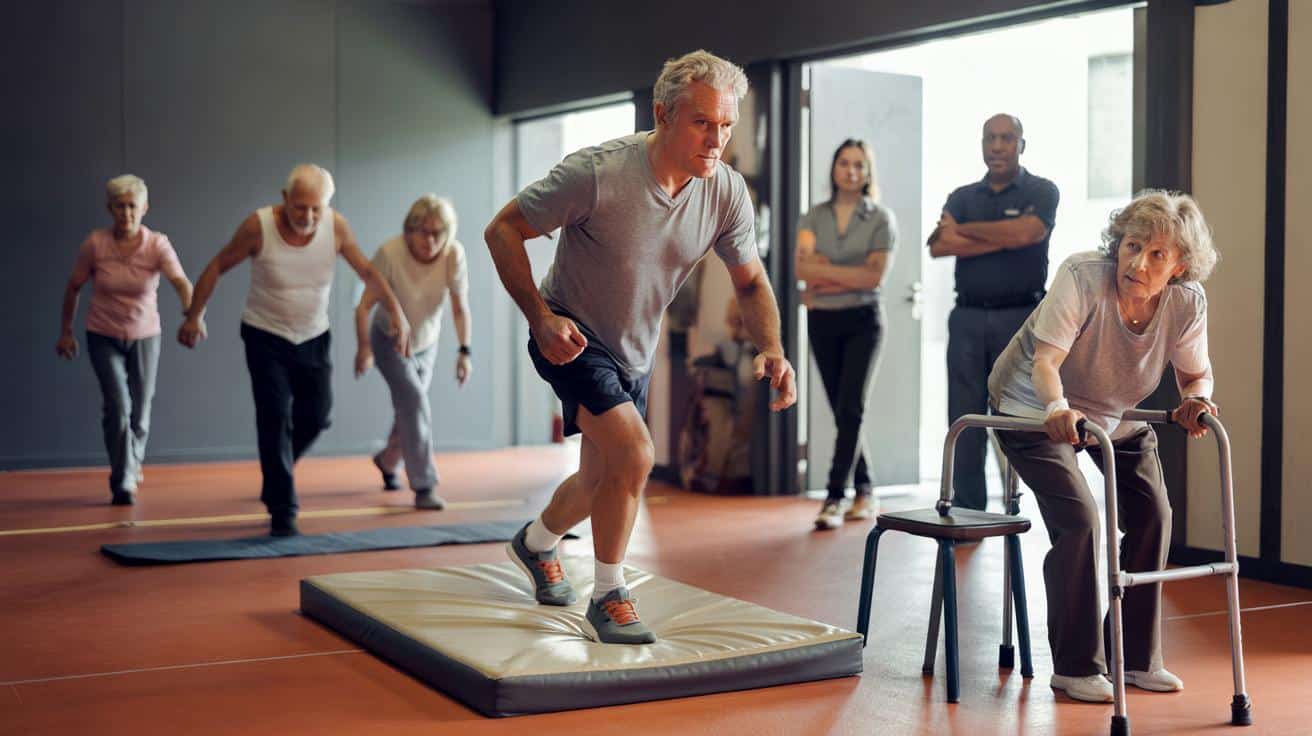
At 9:15 a.m., the elevator doors open and a slow river of gray hair and bright sneakers spills into the community gym. Someone’s walker squeaks. Someone else laughs too loudly. At the back of the room, a retired accountant named George is standing on one leg, eyes fixed on a dot on the wall, arms out like a tightrope walker who took a wrong turn at 75.
The young trainer beside him counts out loud, “Eight… nine… ten,” while an older woman in the front row mutters, “They’re going to break us before lunch.”
Outside, in the hallway, two physiotherapists are arguing in hushed voices about the same class. One calls it a “life-saving balance boot camp.” The other calls it “risky overkill for people who only came here for gentle stretching.”
Somewhere between those two voices sits the uncomfortable truth.
Why balance training for seniors is suddenly so controversial
Walk into any senior center right now and you’ll notice something new. Alongside bingo nights and blood pressure checks, there’s a board filled with flyers for *“fall-proof your body”* classes, “neuro-balance drills,” and “anti-fragility training for retirees.”
For every flyer, there’s a debate. Some doctors are cheering these tougher programs, saying they slash fall risk and keep older adults independent longer. Others look at the same exercises — single-leg stands on foam pads, eyes closed, twisting with weights — and wince.
The question hangs in the air: are we empowering seniors or quietly daring them to fall?
Take the story of Lydia, 78, a former librarian from Phoenix. Two years ago, she slipped on her kitchen floor reaching for a glass and broke her wrist. Shaken, she started a gentle balance class, the kind where you mostly hold on to a chair and breathe.
She got bored. She wanted to feel strong, not fragile. Her instructor nudged her into a more demanding “fall-prevention lab” at the same center. Three months later, she was doing tandem walks on a taped line, light lunges, and standing marches without holding on.
Her doctor said her balance tests improved by nearly 40%. She hasn’t fallen since. Yet in the same class, another man left after two sessions, saying the drills “felt like a lawsuit waiting to happen.”
➡️ Psychology explains why some people always speak very loudly
➡️ How a single unclear expense category can throw off an entire monthly budget
What’s really going on is a collision between two images of aging. One sees older adults as porcelain dolls in comfortable shoes. The other sees them as under-trained athletes who’ve been benched for no real reason.
Both frames miss something. Fragility is real once bone density drops and chronic conditions pile up. But so is the body’s stubborn ability to adapt, even past 70, if you stress it just enough — not too little, not too much.
That slim middle zone is where the controversy lives, and where the most interesting balance work happens.
The “risky overkill” drills experts secretly swear by
Strip away the drama and the most controversial balance exercises for seniors boil down to three moves: standing on one leg, changing your base of support, and challenging your eyes and head.
Start with the simplest version: stand behind a solid chair, fingertips on the backrest. Lift one foot an inch off the floor and hold for 5–10 seconds, then switch. When that feels almost boring, try it with just one fingertip. Later, with your hands hovering.
The so-called “overkill” version is the same move done on a folded towel or foam pad, sometimes with the eyes gently closed or the head turning side to side. That mixed signal to your brain — feet unstable, eyes confused — is what rewires your balance system. Done right, it looks scary, but it’s more science than stunt.
This is where people quietly go wrong. They see a video of a 75-year-old doing single-leg deadlifts on Instagram and jump straight to the advanced version. No warm-up, no progression, no safety setup.
Real progress looks far less glamorous. It starts with a stable surface, a clear escape path, and something sturdy at arm’s reach. It means stopping one step before you feel panic, not one step after.
Let’s be honest: nobody really does this every single day. Most seniors who benefit from tougher balance work show up two or three times a week, gradually layering complexity — a softer surface, a longer hold, a small turn of the head — and backing off the moment their form crumbles.
At the heart of the debate is a blunt question: who gets to decide how “frail” an older body is — a chart, or the person living in that body?
“People don’t fall because they did too much balance training,” says Dr. Anjali Rao, a geriatrician who runs a research clinic on mobility. “They fall because the real world is chaotic, and we never prepared them for anything beyond the hallway rail and the chair.”
The experts who defend more intense balance drills for seniors tend to insist on three guardrails:
- Always have a “backup” — a counter, rail, or stable chair within grabbing distance.
- Progress one variable at a time — softer surface, longer hold, or less visual input, never all three.
- Stop while you still feel in control — wobbling is good, wild flailing is your red light.
Those who call it overkill aren’t wrong about the risk. They just don’t always see the quiet, methodical way the safest programs are built.
Between fear and overconfidence: where real safety lives
Somewhere between the senior who won’t walk without a cane indoors and the one who brags about hiking alone on icy trails at 82, there’s a more grounded path. That path accepts that falls are a leading cause of injury and death in older adults, and still refuses to turn aging into a glass box.
For many families, the tension shows up around the dining table. Adult children beg their parents to “take it easy” while those same parents are quietly terrified of the day someone suggests assisted living. Both sides are talking about the same thing: control.
The uncomfortable reality is that challenging balance work, even the stuff some experts dismiss as aggressive, is one of the last levers seniors can pull to keep control a little longer.
| Key point | Detail | Value for the reader |
|---|---|---|
| Start simple, then layer difficulty | Begin with chair-supported stands, progress to softer surfaces and head turns gradually | Reduces fall risk while still gaining strength and confidence |
| Safety setup matters more than the exercise | Use stable furniture, clear floor space, and a “backup” support within reach | Makes even advanced drills dramatically safer at home |
| Challenge beats coddling for long-term independence | Appropriately stressful drills train the brain, muscles, and reflexes together | Helps seniors stay independent in messy, unpredictable real-world situations |
FAQ:
- Question 1Are these “harder” balance drills really safe for seniors over 70?
- Answer 1They can be, if they’re scaled correctly. That means starting with supported versions, having a stable object within reach, and progressing gradually. The danger usually comes from skipping steps, not from the exercises themselves.
- Question 2What’s one controversial exercise I can try without feeling reckless?
- Answer 2A simple one-leg stand behind a sturdy chair. Lightly hold the back, lift one foot an inch, and hold 5–10 seconds. When that’s easy, reduce your grip, then try it on a folded towel. Stop the moment your wobble feels out of control.
- Question 3How often should a senior do balance work to see results?
- Answer 3Most studies use 2–3 sessions a week, 10–20 minutes each. Some people like short daily bursts, but consistency over months matters more than a perfect schedule.
- Question 4What are red flags that an exercise is too extreme?
- Answer 4If you can’t set up near support, if your feet feel completely out of control, or if your heart is racing from fear rather than effort, the drill is too far ahead. Pain, spinning dizziness, or sudden weakness are also signs to stop immediately and talk to a professional.
- Question 5Should every senior get cleared by a doctor before starting?
- Answer 5If there’s a history of serious heart issues, recent falls with injury, or conditions like advanced Parkinson’s, a medical check and a physical therapist’s input are wise. For many relatively active seniors, starting with basic, supported balance work at home is a low-risk first step.