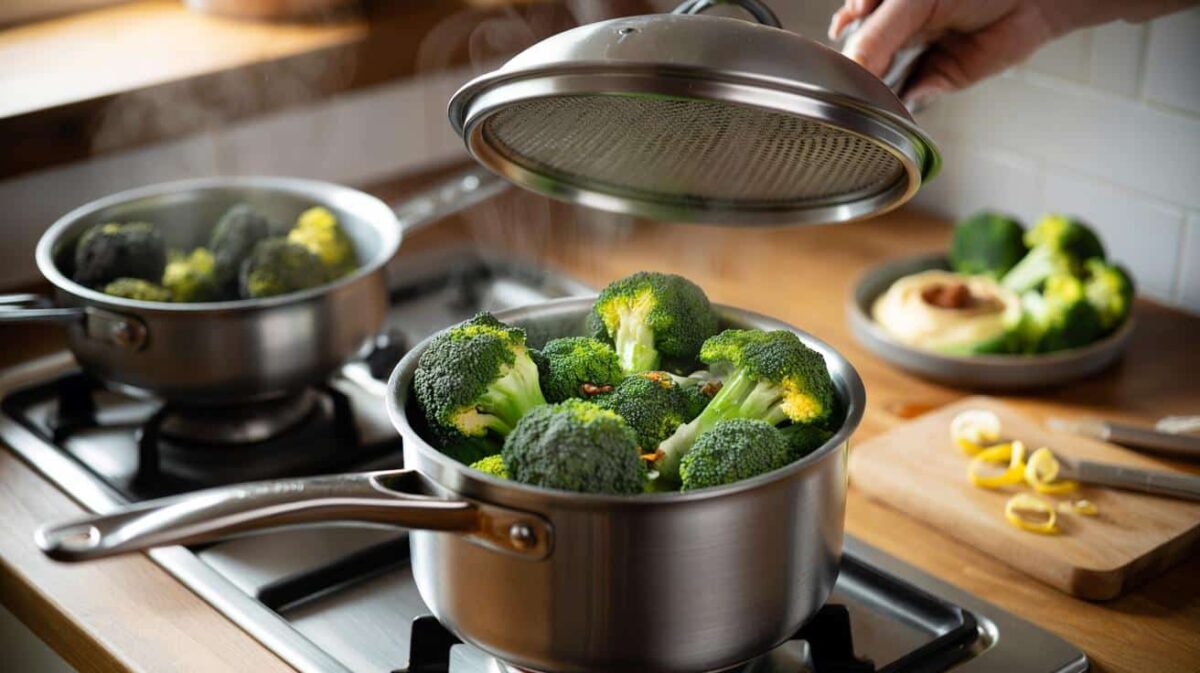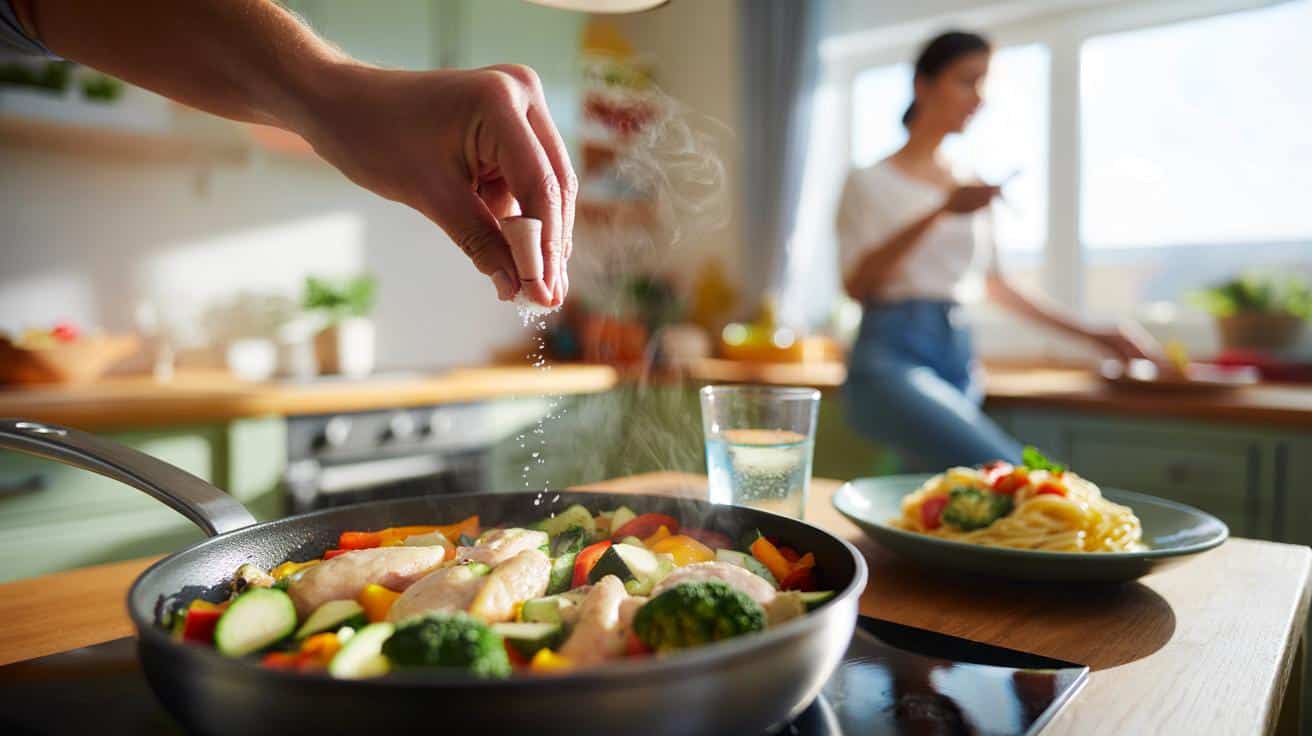
The pan was still hot on the stove when the familiar heaviness crept in.
Dinner had been good, full of color, perfectly seasoned, the kind of meal you’d be proud to post.
Yet fifteen minutes later, you’re on the couch, hand on your stomach, vaguely annoyed at yourself and your “good intentions”.
You ate real food.
You didn’t overdo the portion.
So why does your body feel like it’s working overtime just to process a simple plate of pasta and vegetables?
This tiny discomfort often becomes the soundtrack of weekday dinners.
You eat, you sigh, you promise to “eat lighter tomorrow” without really knowing what that means.
Then one day, you change one tiny thing in the kitchen.
And suddenly, the exact same meal feels… lighter.
Almost effortless to digest.
The surprise is that the magic isn’t on the plate.
It’s in *when* you salt your food.
The tiny cooking change that quietly transforms digestion
Most of us throw salt in at the start.
Right after the oil, almost without thinking, like a reflex learned from watching our parents cook.
The onion hits the pan, the vegetables follow, and the salt rains down.
It smells good, it sounds right, it feels like the “proper” way to cook.
Yet that simple gesture can make your meals heavier than they need to be.
Not dramatically, not in a way you’d catch at first bite.
But your stomach notices.
Your digestion notices.
The slight bloat, the thirst, that slow, dragging feeling after dinner?
They’re shaped, in part, by that early pinch of salt.
Picture this.
Same dish, two versions.
A vegetable stir-fry with chicken and rice.
Version A, you salt everything early, from the first sizzling minute.
Version B, you cook the vegetables almost through, let the chicken brown, then add salt and a splash of water at the very end.
➡️ This Ancient Deadly Disease Is Growing More Resistant To Antibiotics, And Experts Are Worried
➡️ What it reveals psychologically when you feel uncomfortable receiving compliments
➡️ The United States Wants To Use A Supersonic Jet Turbine To Power Its Data Centres
➡️ How to permanently block cold calls on your Android phone
➡️ If, Between 65 And 80, You Still Do These 9 Things, You Really Are One Of A Kind
People who test both often say the second feels “lighter”.
They eat the same quantity, they chew at the same pace.
But their body reacts differently.
In some small studies, meals with higher sodium concentration have been linked to slower gastric emptying and increased water retention.
More salt pulls more water into the digestive tract and into your tissues.
You don’t need a lab coat to know that extra water and higher sodium can translate into that swollen, tight sensation after a big dinner.
Here’s the plain truth: **our body reads salt like a signal**.
Too much, too early in the cooking process, and your plate subtly changes.
Vegetables lose water and texture, sauces thicken and concentrate, and you quietly slide from “gentle” to “dense”.
When salt hits food early, it draws water out.
That means your dish often ends up slightly drier and more compact, even if you don’t see it.
Your stomach then receives something more concentrated in salt and less naturally juicy.
So that same plate of pasta, with sauce cooked long and salted from minute one, will hit your digestion differently than pasta tossed quickly in a lightly salted, short-cooked sauce at the end.
On paper, same ingredients.
In your body, not the same story at all.
The easy timing shift that makes meals feel lighter
Here’s the small change that quietly changes everything:
Salt later, not sooner.
Cook your vegetables, meat, or grains almost to the point where you’d be ready to serve.
Then add salt towards the end, along with a bit of cooking water, broth, or even just plain water.
Stir, taste, adjust.
Give it one or two extra minutes on low heat so the salt melts into the dish instead of attacking it from the start.
You keep all the flavor, often with **less total salt**, and your food keeps more of its natural moisture and softness.
This simple shift in timing makes dishes feel juicier, less dense, more “slippery” in the mouth.
Your stomach receives something closer to what it actually likes: hydrated, gently seasoned, not a compact salty block.
We’ve all been there, that moment when you finish a home-cooked meal and instantly dream of stretchy pants.
You blame the pasta, the cheese, the dessert.
Rarely the way you seasoned.
Yet heavy digestion isn’t always about quantity.
It’s often about concentration.
Early salting concentrates flavor and density in a way that feels satisfying on the tongue for two minutes and tiring for the body two hours later.
Start playing with late salting and you’ll notice a pattern.
Less post-dinner thirst.
Fewer evenings where you feel you “overdid it” despite modest portions.
Let’s be honest: nobody really changes their entire diet overnight.
But moving salt from the beginning to the end of cooking?
That’s a tiny change most people can live with.
“Once I started salting at the end, my dinners felt different,” says Clara, 36, who cooks for her partner and two kids almost every night.
“We didn’t change what we ate, just how we seasoned it.
We were less bloated, and I didn’t feel like lying down right after eating.”
Now, how do you apply this without overthinking every pan you touch?
You can keep a simple mental checklist:
- Cook ingredients almost through first (vegetables soft, meat browned, grains tender).
- Add salt near the end, along with a spoonful of water or broth.
- Taste, then adjust gently instead of salting “by instinct” at the start.
- Use herbs, garlic, lemon zest, or spices early for flavor without heaviness.
- Keep the last 2–3 minutes of cooking on low heat to blend seasoning, not dehydrate the dish.
This is still everyday cooking.
You’re not turning into a chef.
You’re just moving a single gesture a few minutes later in time, and your body quietly thanks you.
When food feels lighter, life quietly shifts
Something subtle happens when dinner stops weighing on you.
Evenings get longer, because you’re not stuck in that slow, heavy after-meal fog.
You talk more, you scroll less.
You notice that a bowl of pasta can be satisfying and yet not feel like a stone.
A veggie curry can be rich, fragrant, colorful, and still leave you free to go for a walk afterward.
And that changes your relationship with “healthy eating”.
Less punishment, more comfort.
Less guilt, more listening.
*You start to realize that digestion isn’t just about what you eat, but how you prepare it – and when you season it.*
It’s one of those tiny, almost invisible shifts that rarely make headlines.
But once you’ve felt the difference between a salted-early dinner and a salted-late dinner, you can’t really unfeel it.
You just start cooking a little differently.
And your body, quietly, cooks with you.
| Key point | Detail | Value for the reader |
|---|---|---|
| Shift salt to the end of cooking | Add most of the salt in the last minutes, with a bit of water or broth | Meals feel lighter and less dense without changing recipes |
| Preserve moisture and texture | Late salting helps keep food juicier and less concentrated | Reduces that “brick in the stomach” sensation after eating |
| Use less total salt | Flavor stays bright, so you need fewer pinches overall | Supports digestion, hydration and long-term health at the same time |
FAQ:
- Question 1Does salting at the end really change digestion, or is it just about taste?
- Answer 1It’s both. Late salting keeps dishes more hydrated and less concentrated in sodium, which can influence water retention and how “heavy” a meal feels. Many people notice less bloat and thirst when they season later.
- Question 2Will my food be bland if I don’t salt at the beginning?
- Answer 2No. You can build flavor early with onions, garlic, herbs, spices, lemon zest or a splash of wine, then bring everything together with salt at the end. The taste is often more precise and easier to control.
- Question 3Is this tip useful if I already eat quite healthy?
- Answer 3Yes. Even with simple, home-cooked meals, timing of salt can affect how your body experiences food. It’s a fine-tuning gesture that adds comfort on top of already good habits.
- Question 4Does this mean I should stop salting my pasta water?
- Answer 4No, you can still salt pasta water lightly so the pasta has some base flavor. The idea is to avoid oversalting sauces and toppings early on. Finish seasoning once everything is combined.
- Question 5How quickly will I feel a difference after changing my salting routine?
- Answer 5For many people, the effect is noticeable within a few meals: less post-dinner heaviness, less intense thirst, a more “calm” feeling in the stomach. It’s subtle but surprisingly consistent once you pay attention.