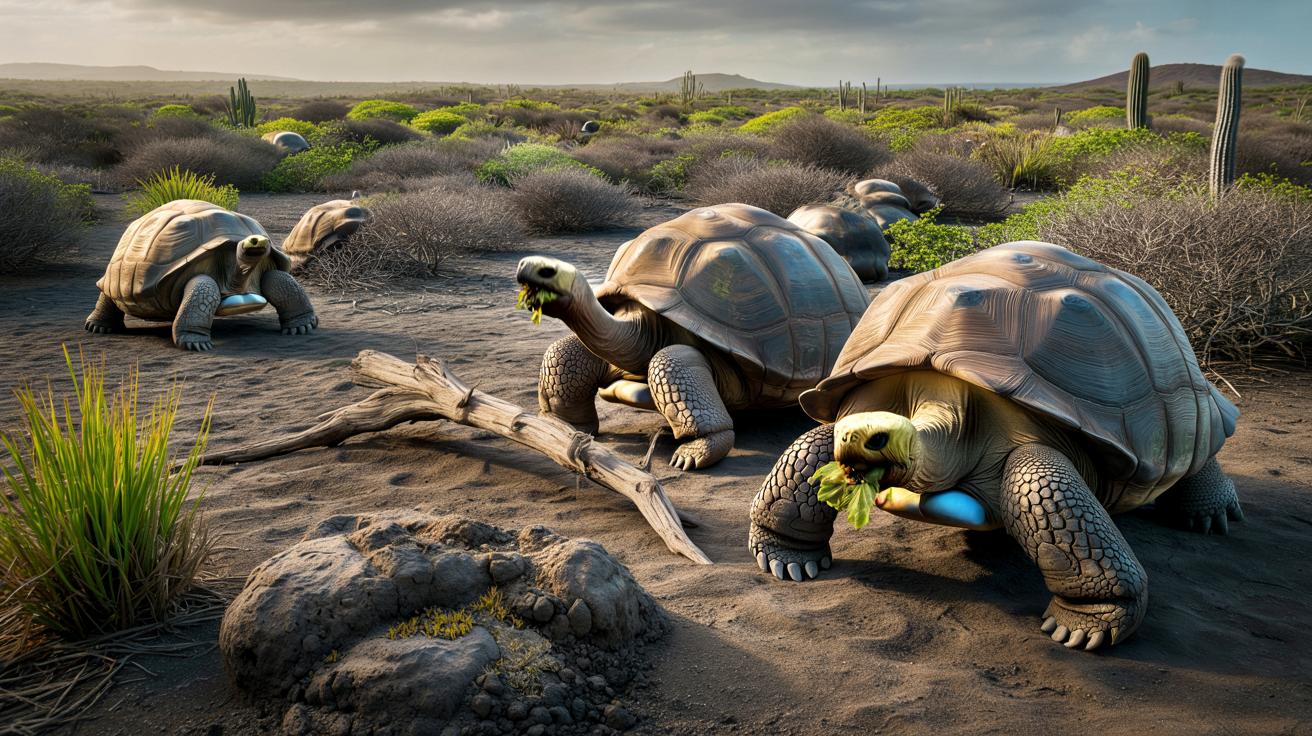
The first sound is crunching. Dry twigs, brittle leaves, volcanic gravel under the slow, deliberate weight of a giant shell. The air on Española Island is already hot, even though it’s barely past sunrise, and a low shape slides through a tangle of thorny shrubs like a living bulldozer. A Galápagos giant tortoise lifts its head, jaws green with chewed leaves, then leans in to snap another branch that’s been shading this slope for years.
Behind it, another tortoise follows. Then another. And another.
What looks, at first glance, like destruction is something else. Shrubs are falling, seeds are being dropped, soil is being scratched open. More than 1,500 tortoises, brought back to an island that had almost lost them, are quietly re‑engineering an entire ecosystem.
The strangest thing is how normal it looks.
When “too many” tortoises are exactly what the island needed
Walk across parts of Española today and you’ll see trails that didn’t exist twenty years ago. Low corridors have been pressed through thickets of woody plants, dug into the ash-grey soil by the same slow feet, over and over. Every few meters, there’s tortoise dung: dark, fibrous, packed with seeds that glint like tiny marbles when the sun catches them.
It’s a messy landscape at eye level. Broken stems, half‑eaten pads of cactus, crushed shrubs. But when you step back, the pattern feels almost deliberate, like someone has been gently rearranging the furniture of the island.
For most of the twentieth century, that furniture was falling apart. Goats introduced by humans stripped Española almost bare, gnawing down native plants and carving deep scars into the vegetation. By the 1960s, only a handful of giant tortoises were left on the island, unable to breed fast enough to outpace poaching, predators and habitat loss.
So conservationists did something bold. They rescued the last surviving adults, bred them in captivity and, over decades, sent their descendants back home. Today, more than 1,500 giant tortoises roam the island again, a living experiment in ecological restoration that’s playing out in slow motion on volcanic rock.
Their impact is not subtle. As these heavy grazers tear down shrubs, they open up light for low-growing plants and help native grasses return. Seeds swallowed with fruits and leaves are carried across long distances, then dropped into fresh piles of nutrient-rich manure, right where new plants stand a chance.
Ecologists who track vegetation plots have watched as once-dense shrubland starts to break up into a more open mosaic, with cactus, herbs and young trees poking through. **The tortoises are not just surviving; they’re turning the key in broken ecological processes that had seized up decades ago.** Long-gone patterns of grazing, trampling and seed dispersal are flickering back to life, step by slow step.
➡️ Psychologists agree: “Life feels lighter the day you stop measuring your worth by this”
➡️ Some people talk incredibly loudly: What that reveals about their character
➡️ Ways to organize your closet so that getting dressed in the morning feels effortless and saves time
How a tortoise rewrites an island, one bite and one seed at a time
Restoring an ecosystem with animals starts with a surprisingly precise choreography. When baby tortoises are raised in breeding centers, staff weigh them, log every growth spurt, and feed them native plants so their guts “learn” the local diet long before they ever see wild soil. When they’re big enough to survive on their own, helicopters or boats carry them back to Española and release them in chosen areas, close to patches that can bounce back.
Then the tortoises simply do what tortoises do. They walk, they eat, they rest in shady hollows. And, without knowing it, they map out new life.
One field ecologist told me about following a young male for an entire morning. The tortoise lumbered straight through a thorny shrub, snapping twigs that would have taken years of wind to break. Fifteen minutes later, he stopped under a spiny cactus, reaching up like a living step stool to nibble at fallen pads other animals couldn’t reach.
A week after that visit, the same researcher came back and found tiny seedlings emerging near the tortoise’s old dung piles: cactus, herbs, and a few hardy shrubs. *A single morning’s wandering had rearranged the plant neighborhood for years to come.* This is the kind of quiet, low‑drama shift no satellite will ever pick up, yet it’s exactly what brings a battered island back from the brink.
From a distance, we tend to imagine “restoration” as tree‑planting campaigns or people hauling seedlings up steep slopes. Giant tortoises flip that image. Their method is slowness, repetition, and brute force applied at ground level. They chew down invasive or over-dominant shrubs that had spread in their absence, grind seeds in their stomachs and carry them to new microhabitats as they roam for water and shade.
Let’s be honest: nobody really does this every single day with human hands and shovels. You need a partner that lives on the land, year-round, generation after generation. **Rewilding with tortoises is a way of outsourcing the hardest part of the job to an animal that evolved for it.** Suddenly, “maintenance” isn’t a line in a budget; it’s a living, breathing shell moving across the lava.
What the return of the giants quietly teaches us
If there’s a “method” hidden inside the Galápagos story, it’s this: start with the engineers, not the decorations. Conservation teams didn’t focus first on planting every missing species of shrub or flower. They poured energy into bringing back a keystone animal whose normal behavior reshapes everything else.
For anyone watching from afar, this flips a familiar script. Instead of asking, “What should we plant?” the better question becomes, “Which animal, if it came back, would restart the processes we can’t fake?”
Of course, in real life, that’s messier than it sounds. We’ve all been there, that moment when you want a neat, uplifting story and instead get a tangle of compromises and “almosts.” Some people worry that so many tortoises might overbrowse certain areas or make life harder for specific plants. Others fear that focusing on a charismatic species lets us feel good while climate change, plastic pollution and illegal fishing keep grinding on in the background.
Those doubts don’t cancel the progress, but they keep it honest. **Restoration is not a fairy tale where everything snaps back to exactly how it was.** It’s more like guiding a river that’s found a new course, nudging it away from cliffs without pretending you control every drop.
“From a distance, people see giant tortoises as symbols of slowness,” one Galápagos ranger told me. “Up close, you realize they are engines. You hear them breathing, you see the shrubs they’ve knocked down, and you suddenly understand that this entire landscape once moved differently, and is learning to move that way again.”
- Giant tortoises tear down dense shrubs, opening light and space for other plants.
- Their droppings act as mobile seed banks, spreading and fertilizing native species.
- Trampled paths create microhabitats used by insects, lizards and ground‑nesting birds.
- By reshaping vegetation, they also influence soil moisture and erosion patterns.
- Their return offers a living model for rewilding other degraded islands and coasts.
When an ancient animal becomes a glimpse of the future
Stand on a rise in Española during the late afternoon and you can see the past and the future sharing the same patch of ground. Dust lifts in pale veils behind moving shells. Frigatebirds circle overhead, watching for lizards that might dart from the tortoises’ disturbance. In places that were once choked with woody scrub, you now spot open clearings with young cactus, grass shoots, and the shy return of plants that hadn’t sprouted there in living memory.
This isn’t a miracle cure. The ocean is still warming, El Niño still hits hard, and one cyclone could redraw the map overnight. Yet there’s something stubbornly hopeful in watching a creature that can live more than a century do quiet work for a future it will never see, carrying seeds it will not live long enough to shade under.
Maybe that’s the real lesson hidden in all those crunching footsteps: some of the most powerful climate and biodiversity solutions won’t look like gleaming technology or perfect plans. They’ll look like old animals doing ordinary things in the one place they evolved to do them, while we, for once, step back far enough to let an ecosystem remember itself.
| Key point | Detail | Value for the reader |
|---|---|---|
| Keystone species matter | Giant tortoises act as ecosystem engineers by grazing, trampling and spreading seeds. | Helps you see why some animals are prioritized in restoration projects. |
| Processes over quick fixes | Reintroducing tortoises restarts natural cycles humans can’t easily replicate by hand. | Invites a shift from one‑off actions to long‑term ecological thinking. |
| Rewilding is a model | The Galápagos project offers lessons that can inform restoration on other islands and coasts. | Gives a hopeful, concrete example you can share in debates about conservation and climate. |
FAQ:
- Question 1How many giant tortoises have been reintroduced to Española in the Galápagos?
- Question 2Why are giant tortoises so important for the island’s ecosystem?
- Question 3Do tortoises really help plants grow by tearing down shrubs?
- Question 4Could this kind of rewilding work in other parts of the world?
- Question 5As a reader far from the Galápagos, what can I actually do with this story?