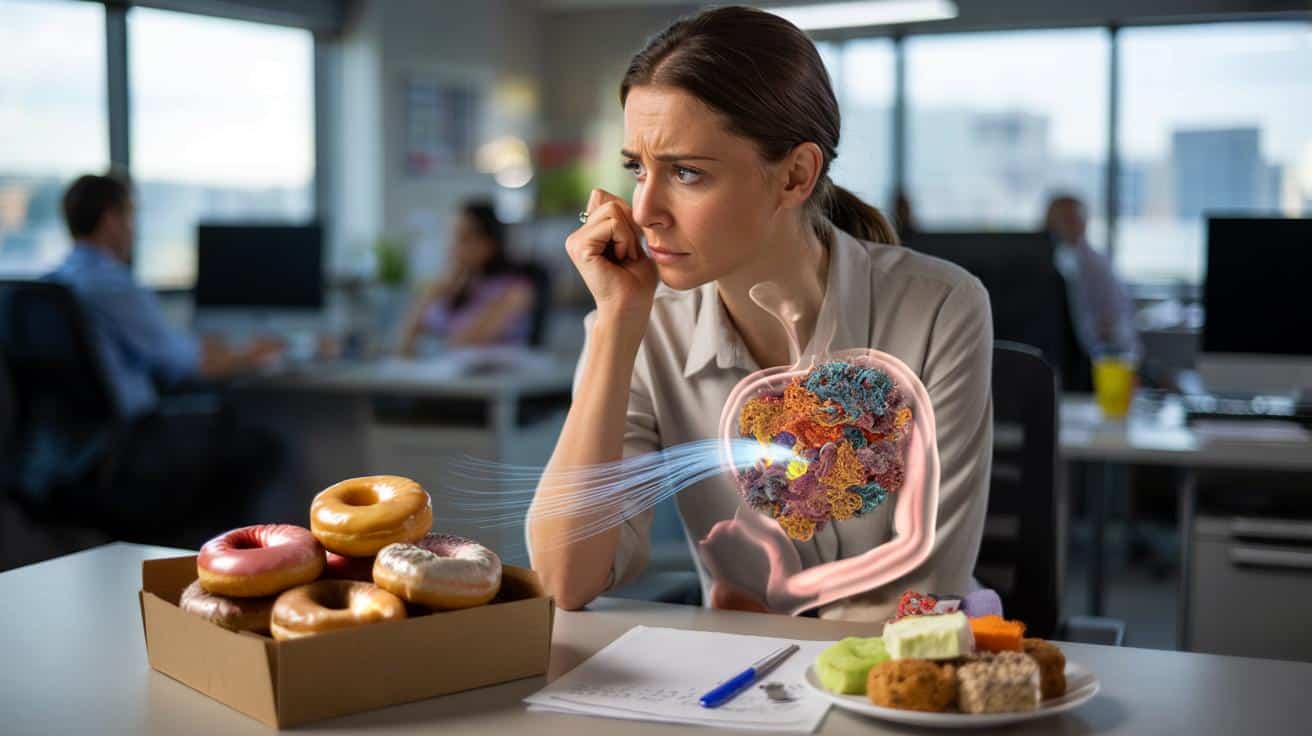
At 3:17 p.m., the office was quiet except for the sound of keyboards and the soft rustle of snack wrappers. Mia stared at the shared table where someone had dropped a box of glazed doughnuts, still warm, shining slightly under the neon light. She’d promised herself that *today* would be different. No sugar till dinner. Clean slate, new her, all that.
Ten minutes later, a half‑eaten doughnut sat on a napkin by her mouse. Her stomach felt heavy. Her brain felt foggy. And in the middle of it all, there was this strange, almost physical tug in her belly, like something deeper than “willpower” had quietly reached for the box before she did.
Mia looked around to see if anyone had noticed.
Inside, a small, unwelcome question had already started whispering.
The quiet gut whisper that beats the loud sugar scream
Most people think cravings erupt from the brain like fireworks: bright, loud, irresistible. The truth is far less glamorous and much stranger. Down in your gut, trillions of bacteria are quietly lobbying for their favorite fuel. Some thrive on fiber, some love healthy fats, and some, frankly, act like tiny sugar addicts.
When you feel that wave of “I need chocolate now, or I’ll lose it”, part of that storm may be coming from your microbiome. The communication line between gut and brain, via the vagus nerve and hormones, is more like a busy group chat than a one-way order.
And sometimes, the loudest voice is not yours.
Researchers from several teams have started to map this invisible war. In one often-cited study, scientists showed that certain gut microbes actually release compounds that tweak appetite and mood, nudging animals toward the foods that favor those microbes’ survival. That sounds sci‑fi, but it’s increasingly treated as biology, not fantasy.
Imagine you’ve been living on sugary cereal, white bread, and sweetened coffee for years. You’re not just feeding yourself. You’re feeding a specific crowd of microbes that flourish in that environment. Pull away the sugar suddenly and those microbes “complain” by influencing hunger hormones, cravings, even your stress response.
You feel weak. You think you’ve failed. On the microscopic level, it’s more like a desperate bacteria lobbyist losing its contract.
➡️ This European country challenges its arms industry with a homegrown rival to the Tomahawk missile
➡️ Neither boiled nor raw : the best way to cook broccoli to preserve maximum antioxidant vitamins
➡️ Have you ever tried cloud eggs? This light way to cook them
➡️ He disappears in 2026: the tax break millions of households will lose
➡️ After Replacing 90% Of His Staff With AI, An Indian Founder Reveals An Unexpected Outcome
➡️ Interior Design: Why going slow will save you money in the long run
This gut‑brain story begins to poke a stick into an old, touchy debate. If our microbes can push us toward sugar, how much of “gluttony” is actually character, and how much is chemistry?
Some argue that calling overeating a disease lets people off the hook, that it erases responsibility. Others say ignoring the biological drivers is like blaming an asthmatic for wheezing during a run.
The emerging science on the microbiome does not absolve anyone of choices. It simply stretches the frame. Hunger is no longer just about an open fridge and weak will. It’s also about which tiny tenants live in your gut and what they’re whispering into your nervous system, all day long.
Feeding the right microbes so cravings shrink quietly
One practical way to turn down sugar cravings is to stop fighting them head‑on and start rewiring the gut conversation instead. That means feeding the bacteria that love slow, stable energy, and slowly starving the ones that scream for quick sugar hits.
The strategy looks more like gardening than war. Add a little more fiber each week. Swap the afternoon pastry for a handful of nuts and a piece of fruit. Slide some fermented foods onto your plate: plain yogurt, kefir, kimchi, sauerkraut, miso.
Over time, the microbial balance shifts. The gut messages change tone. The loud “give me sugar now” becomes a mutter. Sometimes, it just… fizzles.
Here’s where most people get stuck: they expect peace after three days. Sugar cravings spike, their mood drops, and they decide this “healthy gut” thing is a scam. We’ve all been there, that moment when you stand in front of the fridge at 10 p.m., trying to negotiate with a jar of Nutella.
What’s rarely said out loud is that the first days of changing your microbiome can feel like withdrawal. Your old microbes are losing their favorite food source. You feel edgy, tired, maybe a bit sad.
This is not moral failure. It’s biology in real time. The trap is to read a temporary discomfort as permanent identity: “I’m just weak”, “I’m a sugar person”, “I’m a glutton”.
Let’s be honest: nobody really does this every single day without slipping. Which is why the people who realistically reshape their relationship with sugar often work with a rule that’s boring but powerful: don’t aim for purity, aim for momentum. One step better than last week. One more vegetable, one less hidden sugar.
“Once I stopped calling myself greedy and started calling myself ‘a body in transition’, everything softened,” says Léa, 41, who spent two decades bouncing between diets. “The cravings weren’t proof I was broken. They were proof my gut was still wired for my past. That changed how I treated myself on the hard days.”
- Swap “I am gluttonous” for “My gut is still wired for sugar right now”.
- Keep one simple habit for 30 days: a fiber‑rich breakfast, or a daily fermented food.
- Expect discomfort and plan for it: tea, phone a friend, a walk, not just white‑knuckling.
- Use curiosity instead of shame: “What did I eat earlier that might be feeding this craving?”
- Notice small wins: one less spoon of sugar, one craving that passed, one evening without a binge.
Is gluttony a sin, a symptom, or something messier?
Once you start listening to the gut’s quiet signals, the old moral language around food starts to feel a bit… shaky. Calling someone “gluttonous” flattens a layered reality into a single insult. Yet many people still feel that sting when they reach for a second slice of cake, as if their entire worth is stacked on that plate.
The biology doesn’t cancel the ethics. You still live in a body that acts in the world. Your food choices ripple into health systems, family habits, your own future. But the lens can shift from blame to responsibility: not “I am bad”, but “I am in a complex tug‑of‑war, and I still have some say in the rope.”
For some, framing overeating as a disease feels like a relief. A medical label can open doors to treatment, empathy, even insurance coverage. For others, it feels like a theft of agency, as if their story has been reduced to a diagnostic code on a screen.
Reality probably sits in a muddy space between those poles. There are clear biological forces: genetics, hormones, trauma, microbiome shifts after antibiotics, ultra‑processed food engineered for overconsumption. There’s also culture, habit, and the deep human urge to self‑soothe in a harsh world.
Calling everything “willpower” erases the science. Calling everything “disease” can erase the person.
So the next time you feel a sugar wave rising, you could run the old script: “Here I go again, no control, typical me.” Or you could pause for half a breath and imagine it differently.
Picture your gut as a crowded town square after years of candy festivals. Of course the vendors are shouting. Of course the streets smell like caramel. You start inviting in different stalls, quieter ones, with lentils and yogurt and apples. At first, they barely get noticed. Over months, the crowd slowly shifts.
That’s not sin. That’s not pure disease. That’s adaptation. And it might be the most honest way to describe what’s happening when the gut’s whisper finally grows strong enough to stand up to the sugar roar.
| Key point | Detail | Value for the reader |
|---|---|---|
| Gut microbes influence cravings | Certain bacteria push for sugary foods by affecting hunger and mood signals | Reduces shame by showing cravings are partly biological, not just “weak will” |
| Feed the “calm” microbiome | More fiber, fermented foods, and slow carbs gradually change gut signals | Offers a concrete path to quieter sugar cravings over weeks and months |
| Reframe “gluttony” | See overeating as a mix of biology, habit, and responsibility, not pure moral failure | Helps build kinder self-talk and more sustainable behavior change |
FAQ:
- Is sugar addiction a real thing or just an excuse?There’s no universal medical definition of “sugar addiction”, but studies show sugar can trigger reward pathways similar to addictive substances in some people. Combine that with gut microbes that favor sugar, and the experience can feel very real, even if the label is debated.
- How long does it take for gut changes to reduce cravings?Some people notice slight changes within 1–2 weeks of eating more fiber and fewer ultra‑processed foods. Meaningful, more stable shifts often take 6–12 weeks, especially if your past diet was very high in sugar.
- Can I ever eat dessert again if I want to “retrain” my gut?Yes. The goal isn’t a sugar‑free life sentence. It’s building a gut environment and a set of habits where dessert is a choice, not a compulsion that steamrolls you every afternoon or late at night.
- How do I know if my cravings are emotional rather than biological?If cravings surge sharply with stress, loneliness, or boredom and appear even after a full meal, there’s likely an emotional component. Often, both layers are present: a wired microbiome plus learned comfort‑seeking through sweet foods.
- Do probiotics alone fix sugar cravings?Probiotic supplements can help some people, but they’re not magic bullets. They work best as part of a pattern that includes diverse plant foods, enough sleep, some movement, and less ultra‑processed sugar in daily life.