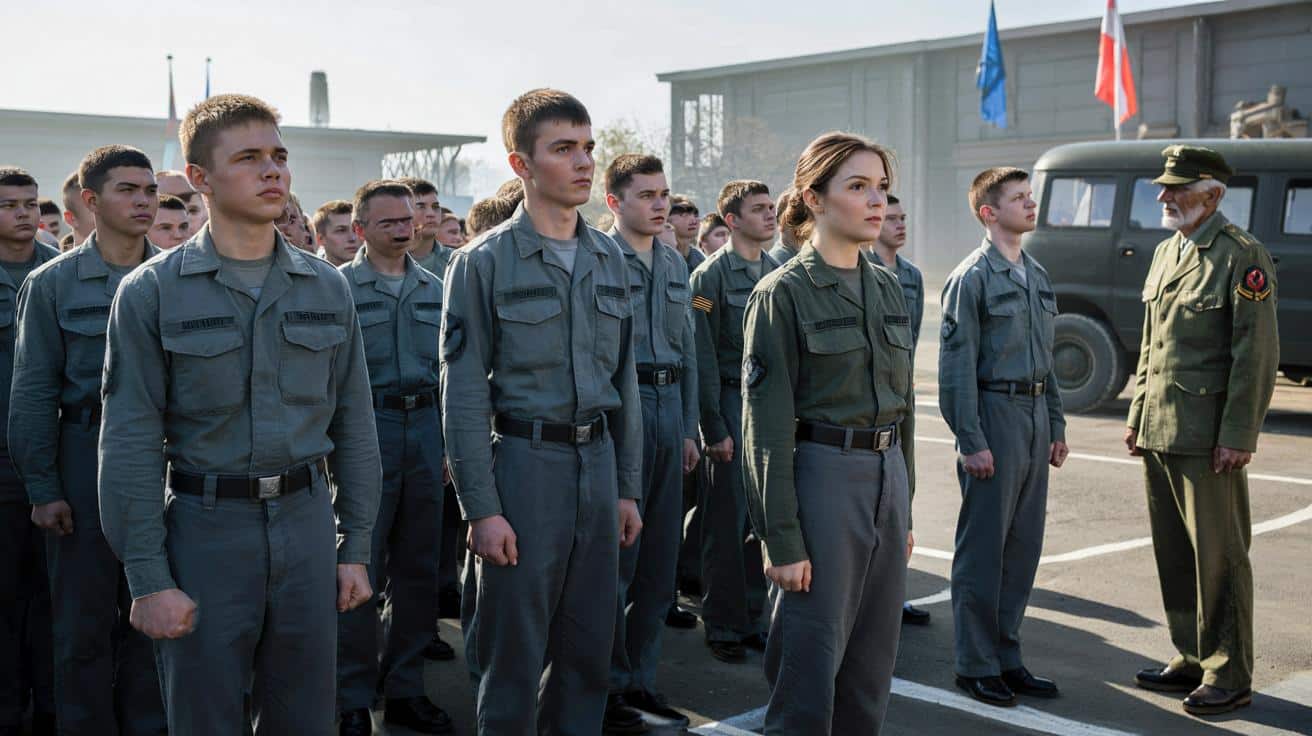
The bus station smelled like energy drinks and cheap perfume. Dozens of 18-year-olds slouched on their suitcases, eyes glued to phones, thumbs twitching on TikTok. A few parents hovered nearby, dragging oversized duffel bags and last-minute advice, while their kids barely looked up.
In one corner, an old veteran in a faded uniform watched them, his back straight, hands locked behind him. He wasn’t angry. Just… puzzled.
What would happen, he asked me quietly, if all of them had to wear the same uniform one year from now? Boys, girls, rich, poor. No excuses. No influencers’ passes. Only the flag above the door and the same thin mattress at night.
The question hung in the air like smoke.
Why mandatory service feels like a slap in the face… and why that slap might be needed
Walk through any high school on graduation week and you can almost feel the invisible script. You’re 18, you “deserve” freedom, a gap year, a MacBook, a shot at going viral. And if life doesn’t instantly bend to your expectations, the meltdown arrives fast.
Now imagine that same hallway under a different rule: at 18, everyone does one year of national service. Military for most, support roles for some. No “my parents know someone” loophole. No “this isn’t my vibe” exit. Just a shared detour where comfort is no longer the main character.
For a generation raised on personal choices, that sounds brutal. Which might be exactly why it’s fair.
Think of countries that still have conscription, like Israel, South Korea, Finland. Ask anyone who’s done it and you rarely get a neutral answer. It’s either “worst year of my life” or “the year that changed me”. And often, it’s both at once.
One Finnish woman I spoke to described arriving at the base in winter, long hair shoved under a beanie, standing in line with farm kids, coders, and the mayor’s son. By day three, nobody cared who had what followers or which car their parents drove. The only thing that mattered was who could stay awake on patrol, who shared their last chocolate bar, who quietly helped the one crying in the bathroom.
That leveling effect is brutal, yes. But it’s oddly democratic.
➡️ You don’t need to be an expert to make this foie gras: I use my microwave and it costs me far less
➡️ Interior Design: Why going slow will save you money in the long run
➡️ Microwaving a lemon : A simple kitchen trick you’ll keep using
➡️ SpaceX in merger talks with other Musk companies ahead of IPO
➡️ Asus permanently quits smartphones to go all‑in on AI
This is the plain truth: comfort has stopped being a treat and turned into a baseline expectation.
When you never have to share a room, clean a toilet that isn’t yours, or be responsible for someone else’s safety, you slowly start to believe that inconvenience is injustice. That a hard task is a personal attack. Mandatory service cuts directly into that story.
Putting every 18-year-old — including women — through the same demanding filter creates a rare social moment: entitlement loses its footing. Respect is no longer a word on a classroom poster. It becomes the officer who covered for your mistake. The medic who patched you up at 3 a.m. The quiet girl who carried your pack when you were about to pass out.
Respect stops being abstract. It has a face, a voice, and sometimes, a rank.
How equal service could reset fairness between genders and classes
Let’s talk about the elephant in the room: including women. For decades, conscription has been a male burden in many countries, with women “free” to choose if they want to serve. On paper, that looks like progress. In real life, it quietly feeds a toxic idea — that defending the country is a guy’s job.
A genuinely equal draft would flip that. At 18, your gender wouldn’t be your ticket out. It would be just another line on your file. You might end up in infantry, logistics, cyber, medical support, disaster response. But you’d be there. Present. Accountable.
That kind of shared responsibility doesn’t erase sexism overnight. It does give young women and young men the same starting ground to earn and give respect. That’s not symbolic. It’s structural.
Class matters here too, more than most people admit. Right now, plenty of privileged kids can float for years on family money, “finding themselves” while other teens jump straight into tough jobs they didn’t exactly dream of. One path gets framed as freedom. The other as failure.
Mandatory service cuts across that divide like a blade. The heir to the family business, the daughter of a cleaner, the kid who almost dropped out — everyone wakes up at the same time, eats the same bland meals, runs the same drills. The wealthy can’t buy a softer mattress. The poor can’t be quietly forgotten.
We’ve all been there, that moment when you suddenly realize the person you judged on appearance is the one who has your back. A mixed platoon of rich and poor, shy and loud, city and countryside, male and female accelerates that moment a hundred times over.
There’s another layer almost nobody talks about: national identity in a fractured, hyper-online world. Youth culture is often more attached to global trends than to the street they actually live on. Same sneakers, same memes, same slang, whether you’re in Paris, Seoul, or São Paulo.
*Mandatory service doesn’t magically create patriotism, but it creates shared memories anchored in real soil, not just in screens.*
That year becomes a reference point everyone understands — the frozen morning runs, the night exercises, the first time you led a small team and didn’t screw it up completely. Respect for the nation stops looking like blind flag-waving and starts looking like a quiet, lived familiarity with its people, its flaws, and its risks.
You can criticize your country. You just won’t be doing it from complete distance.
Turning “forced duty” into something that actually rebuilds character
If we’re going to send every 18-year-old into service, there’s a way to do it that actually works. It starts with clarity: this isn’t a punishment. It’s a national rite of passage with teeth. That means real standards, real discipline, and real consequences, not a glorified summer camp.
Training needs to combine physical drills with mental resilience. Early mornings, yes. Long marches, yes. But also basic financial literacy, emergency response, conflict management, and critical thinking about propaganda. Imagine if every young adult knew how to stop a bleed, read a payslip, and de-escalate a fight.
The mix of toughness and practical education is where “entitled” starts to evolve into “useful”.
Of course, plenty of parents and teens will push back. They’ll worry about safety, lost study time, or simply the shock of leaving home. Some will say their child is “too sensitive” for that world. Others will claim that creativity and freedom are the real paths to growth.
The trap is to romanticize either extreme. Pure discipline with no humanity creates broken adults. Pure comfort with no demands creates fragile ones. The sweet spot is a system that challenges young people hard, then supports them as they grow. That includes real mental health support, fair treatment across genders, and serious consequences for harassment or abuse.
Let’s be honest: nobody really does this every single day in civilian life. That’s what makes a structured year of service so unique — it compresses lessons that might take a decade into twelve intense months.
“Before service, I thought the country owed me everything,” a former conscript told me. “After service, I still had my complaints. But I also knew what I owed the people standing next to me.”
- Rotate roles, don’t box people in
Expose recruits to different tasks: field work, logistics, leadership, support. Hidden strengths often appear where nobody expects them. - Use women as leaders, not just participants
Promote based on performance, not stereotypes. A young woman commanding a mixed unit sends a powerful message about competence and respect. - Offer real civilian benefits after service
Tuition help, hiring advantages, training certificates. The year shouldn’t feel like a black hole but like a launchpad. - Train officers to spot burnout early
A tough environment doesn’t have to be a cruel one. Early intervention can prevent long-term damage and dropout. - Build national service around more than combat
Disaster relief, cybersecurity, medical support, environmental projects. Not every recruit will carry a rifle, but every recruit can carry responsibility.
What kind of adults do we want walking out of that year?
Picture those same 18-year-olds from the bus station one year later. Same faces, different posture. They’ve learned to live without their phones for chunks of time. They’ve stood guard while others slept. Some have failed a course and tried again. A few have discovered that they can lead, even if nobody ever told them so in school.
They won’t all become heroes. Some will stay cynical, some will feel nostalgic, some will be simply relieved it’s over. Yet that shared experience changes the national baseline. It becomes harder to sneer at “the system” when you’ve been part of one that actually worked. Harder to dismiss your country as a vague, corrupt blob when you’ve sweated alongside strangers wearing the same flag.
The question isn’t just, “Should we force every 18-year-old, including women, into service?” The deeper question is, “Do we still believe in any common project strong enough to ask something hard of everyone?”
Because if the answer is no, the issue isn’t the youth.
It’s us.
| Key point | Detail | Value for the reader |
|---|---|---|
| Equal duty for all 18-year-olds | Mandatory service for men and women, across classes | Offers a concrete vision of fairness, not just slogans |
| From entitlement to responsibility | Shared hardship, discipline, and real skills | Shows how character can be built, not just wished for |
| Respect rooted in lived experience | Common memories, mixed groups, national projects | Helps readers rethink what “respect for the nation” can mean today |
FAQ:
- Question 1Would mandatory service for everyone really reduce entitlement in young people?
- Question 2Is it fair to force women into military or national service the same way as men?
- Question 3What about teens who are not physically fit or have health issues?
- Question 4Does a year of service hurt academic and career plans?
- Question 5Could national service work without a strong military component?