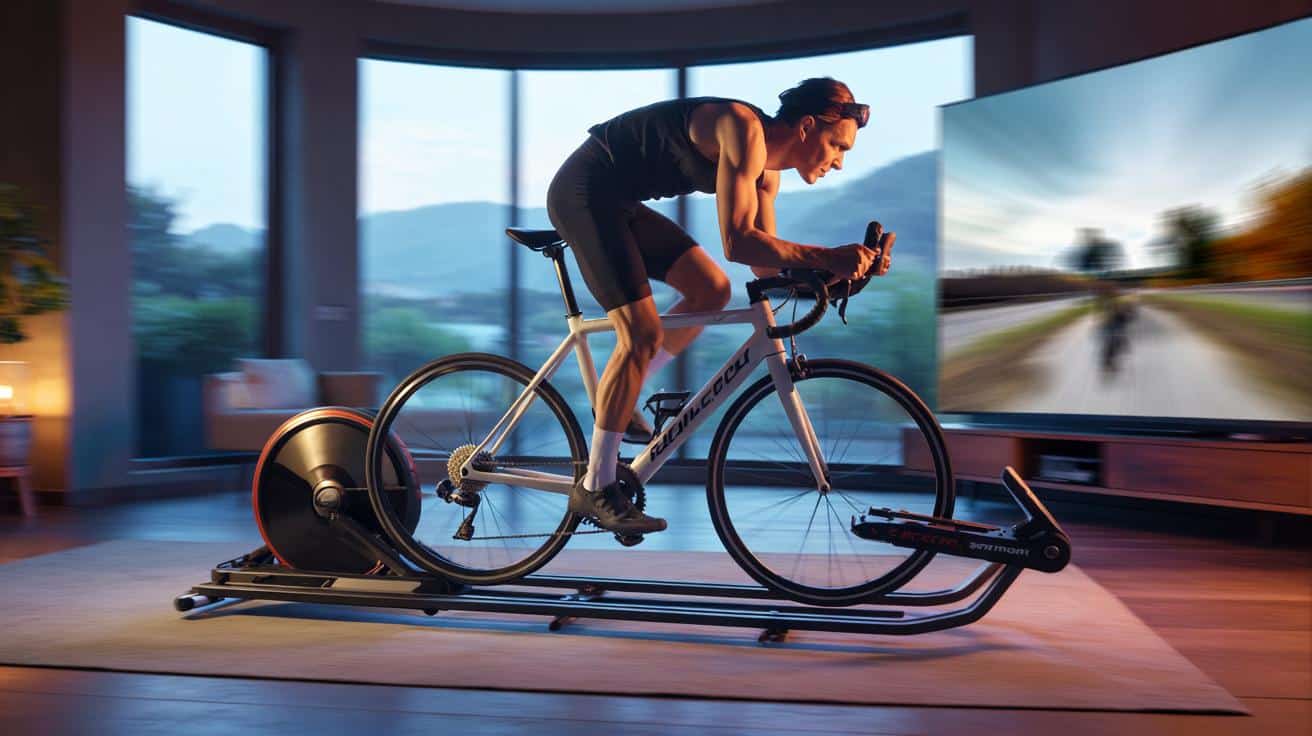
Now the bike itself moves, sways and slides beneath you.
The latest generation of smart trainers does more than just measure power and simulate hills. At around €1600, these new “sliding” systems promise to transform a rigid turbo setup into something that feels uncannily close to riding outside, complete with sideways sway, fore–aft movement and a touch of unpredictability.
From static torture device to moving machine
For years, indoor cyclists have complained about the locked-in feeling of traditional turbo trainers. The rear axle is clamped, the front wheel is stuck, and your body has nowhere to go. Knees ache, backs tighten and long sessions feel more like punishment than training.
Enter the sliding indoor trainer: a platform or frame that allows the bike to move side to side, and sometimes forwards and backwards, as you pedal. The concept is simple. Let the bike and rider rock naturally under load, just like on the road, and your body mechanics improve.
The new sliding trainers are designed to bring outdoor movement into a living room, without sacrificing data or performance.
That promise has turned what used to be a niche DIY project into a full‑blown product category, with premium models costing as much as a good mid-range road bike.
What does a €1600 sliding trainer actually do?
A high-end sliding system usually combines two ideas: a controllable smart trainer and a motion platform. Some brands build everything into one unit, others sell a separate “rocker plate” or sliding base for existing trainers.
- Side-to-side rocking: mimics the bike leaning under you when you sprint or climb out of the saddle.
- Fore–aft sliding: lets the bike move slightly forwards and backwards as you accelerate or hit virtual bumps.
- Controlled resistance: links to apps like Zwift, TrainerRoad or Wahoo SYSTM to simulate gradients and workouts.
- Data tracking: logs power, cadence and sometimes left/right balance, just like regular smart trainers.
Some premium platforms even add small actuators or curved rails that generate subtle motion in response to your pedalling. That movement isn’t random; it responds to how you shift your weight, steer the bars or rock the bike during hard efforts.
Chasing realism in the pain cave
Why all this effort and expense for a ride that never leaves the house? Realism. The more an indoor ride feels like the road, the easier it becomes to stay motivated, push harder and train longer.
The sliding trainer trend grows from a simple idea: if indoor riding feels less like a clamp and more like a bike, people will actually use it.
➡️ Neither boiled nor raw : the best way to cook broccoli to preserve maximum antioxidant vitamins
➡️ From Internship To Impact How Tech Careers Are Launched
➡️ After Replacing 90% Of His Staff With AI, An Indian Founder Reveals An Unexpected Outcome
➡️ France and Germany plan a new “Airbus of military lasers” with MBDA & Rheinmetall joint venture
➡️ India watches nervously as its biggest rival moves to buy 50 new warships
On a traditional turbo, the bike’s stiffness means your upper body takes more strain. Hips stay fixed, shoulders lock, and your core works differently than it does outdoors. A moving setup lets your bike lean gently with every pedal stroke. Your hips can shift slightly, relieving pressure on the saddle. Sprints feel smoother, and climbing out of the saddle becomes a real option, not a sketchy wobble.
Why riders are paying road-bike money
€1600 sounds excessive for something that never touches asphalt. Yet there are several reasons cyclists are reaching for their wallets.
| Reason | What riders say they gain |
|---|---|
| Comfort | Less saddle pain, fewer numb hands, reduced back and knee strain |
| Realism | Outdoor-like movement and balance while using training apps |
| Motivation | Longer sessions feel less monotonous, more like a real ride |
| Performance | Better sprint mechanics and smoother out‑of‑saddle climbing practice |
For riders who spend 5–10 hours a week indoors due to weather or work, that comfort and engagement start looking like a worthwhile investment, especially when compared with the cost of a new aero wheelset or carbon handlebar upgrade.
How sliding trainers actually work
The core technology is not as exotic as it sounds. Most systems rely on relatively simple engineering.
Rocker plates and rails
Many setups use a “rocker plate”: two wooden or composite boards with inflatable balls or elastomers sandwiched between them. The trainer bolts on top, and the bike moves as the upper plate rocks. Add low‑friction rails or wheels underneath, and the whole rig can slide back and forth.
More advanced designs use curved rails or hinged arms to guide this movement, controlling the arc of the lean so you don’t tip over or slide off the platform.
Integrated motion frames
High-end trainers integrate the movement directly into the frame. The rear wheel mount sits on a pivot, while the base uses dampers or springs to control the feel. In some cases, small hydraulic or magnetic units provide resistance to the lean, adjusting how “loose” or “tight” the motion feels.
Although the marketing can sound futuristic, the key innovation is allowing controlled, limited movement rather than absolute stability.
Benefits and trade‑offs of a moving setup
There are genuine gains from letting your bike move, but also a few downsides buyers should weigh up before spending €1600.
The upsides riders actually notice
Most reports from early adopters focus on three main benefits.
- Comfort on long rides: Subtle sway reduces constant pressure on the same contact points.
- More natural sprinting: You can pull on the bars and swing the bike slightly, just as outside.
- Core engagement: Keeping balance on a lean-prone setup quietly asks more of your core muscles.
That last point matters. While sliding trainers won’t replace strength training, they make indoor rides feel less like being bolted to a gym machine and more like a full-body activity.
The potential downsides
Motion comes with trade-offs.
- Stability learning curve: The first few sprints can feel unnerving, especially when standing.
- Space and weight: A sliding platform can be bigger and heavier than a standard trainer.
- Noise and vibration: Movement may add new creaks or thumps to already loud turbo sessions.
- Cost: For many riders, the price rivals the budget for an entire new bike.
Riders used to rock‑solid trainers might need a week or two to fully trust a moving platform under maximal effort.
Is a sliding trainer right for you?
The value of a €1600 moving setup depends heavily on how and where you train. A few scenarios help clarify who stands to gain the most.
If you ride indoors year‑round
For cyclists in northern climates, or those with unpredictable work hours, indoor riding can stretch from a winter compromise to a year‑round habit. In that case, comfort moves from “nice to have” to “non‑negotiable”.
Many endurance riders logging three‑hour indoor sessions report that a moving platform lets them finish with fewer hotspots, less stiffness and a fresher back. That benefit can directly influence how consistently they stick to a structured plan.
If you sprint, race or ride crits
Racers using platforms like Zwift Racing League tend to push high wattages indoors, including all-out sprints. Being able to rock the bike offers two advantages: more realistic sprint posture and better transfer of indoor efforts to outdoor race form.
Practising repeated sprints on a static trainer can train you to keep the bike unnaturally still. Doing the same efforts on a sliding system helps preserve the natural upper-body rhythm used in real races.
Key terms worth unpacking
Two bits of jargon appear frequently in this conversation: “rocker plate” and “fore–aft motion”. Understanding them helps when comparing products.
A rocker plate is simply the lateral rocking mechanism. Think of it as a balance board for your bike and trainer. Cheaper versions use rubber balls for resistance; pricier ones rely on adjustable springs or dampers to tune how quickly the bike returns to centre.
Fore–aft motion refers to the bike sliding forwards and backwards a few centimetres. That motion softens the harsh jolt when you surge out of the saddle. On a completely fixed trainer, your body wants to move forwards, but the frame cannot, so joints take the hit. With fore–aft movement, some of that force gets absorbed by the system rather than your knees or lower back.
Practical tips before spending €1600
Anyone tempted by this trend can run a quick home “simulation” first. Place your front wheel on a slightly soft surface and mount your existing trainer on a thin yoga mat. Even that tiny bit of give can show how a hint of movement changes the feel of a ride.
If that small adjustment reduces discomfort or makes out‑of‑the‑saddle efforts feel more natural, a full sliding system might be worth saving for. Borrowing or testing one in a shop is even better, especially to judge noise, footprint and stability in real sprints.
Some riders choose a middle path: they keep their current smart trainer and add a standalone rocker platform at a lower cost. The experience is not always as refined as an integrated €1600 setup, yet it can deliver much of the comfort and engagement that fuel this new, slightly mad, but undeniably intriguing indoor trend.