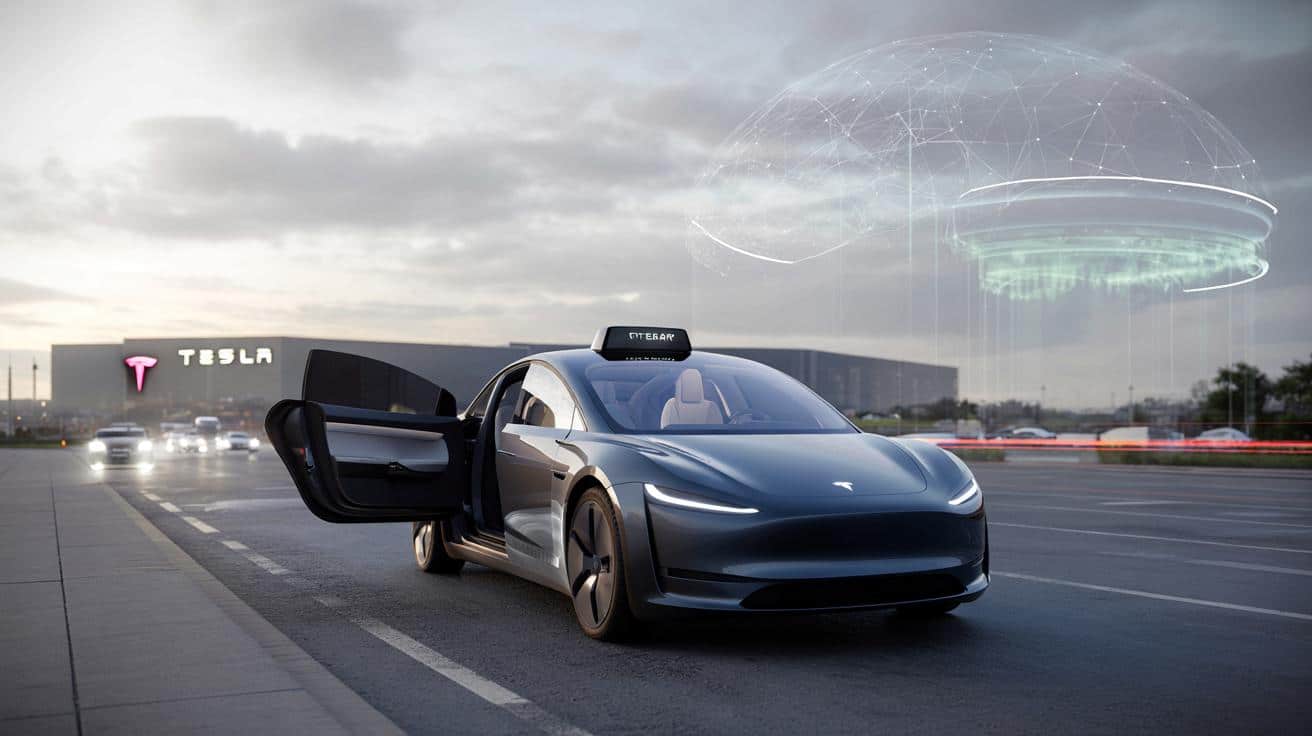
On a gray Monday morning in Austin, the parking lot outside Tesla’s Gigafactory looks oddly calm. No shiny Cybertrucks rolling out, no crowds, just a low buzz from inside the massive building. Yet on the screens in traders’ offices and on phones in coffee shops around the world, Tesla is anything but quiet. A fresh SEC filing lands: Tesla has just plowed $2 billion into Elon Musk’s AI startup xAI, and Musk doubles down on his promise that the robotaxi “Cybercab” will begin production this year.
People scroll, pause, screenshot. Some are thrilled, some roll their eyes, some just wonder what this actually changes for their everyday life behind the wheel.
There’s the sense that a line has been crossed, quietly, while most of us were stuck in traffic.
Something about cars is about to feel very different.
Tesla’s $2 billion bet: when the car becomes a computer that thinks
Walk through the Tesla factory floor today and you’re not just looking at an automaker. You’re watching a company trying to morph into an AI infrastructure giant, right under the fluorescent lights. The $2 billion stake in xAI isn’t a side project; it’s a signal that Tesla wants its cars to run on Musk’s own brainchild of artificial intelligence, not someone else’s black box.
For a company that already treats vehicles like rolling software platforms, this folds the AI core even closer to the metal.
The promise is simple on paper and dizzying in reality: a Tesla that doesn’t just assist your driving, but learns, anticipates, and eventually drives itself as a paid service.
Look at Tesla’s trajectory the past few years. The company didn’t just ship cars; it shipped fleets of moving sensors, hoovering up billions of miles of driving data. Every hard brake, every awkward unprotected turn, every badly painted lane marking. Now imagine feeding that firehose of data into xAI’s models instead of a generic AI stack.
Musk has already teased “TruthGPT” and the Grok chatbot through xAI, but this $2 billion link connects that world directly to Tesla’s hardware.
It’s less about witty chatbots, more about a neural network that can read a busy intersection the way an experienced human driver does on a rainy night.
From Tesla’s perspective, the logic is brutal and clear. If it can own the AI layer that sits on top of its cars, it keeps the whole value chain: hardware, data, software, and subscriptions. No revenue-sharing with outside providers, no dependence on a rival’s roadmap, no begging for access to models.
**That’s the real prize Musk is chasing** as he talks about Cybercabs and robotaxi networks. The car becomes a node in an ecosystem where the most valuable asset isn’t the battery pack, but the intelligence humming quietly behind the screen.
And once that clicks, $2 billion starts to look less like a gamble and more like table stakes.
Cybercab: from sketchy promise to “production this year”
The way Musk tells it, the Cybercab is not just a new Tesla model. It’s the gateway to a future where you hit a button, a driverless car glides up, and nobody touches a steering wheel. The fresh twist: Tesla is reiterating that Cybercab production starts this year. Not “soon”. Not “sometime this decade”. This year.
That timeline might feel absurd if you’ve watched past Tesla delays, but it’s also classic Musk. Aggressive deadlines force suppliers, teams, and investors to treat sci‑fi as a near-term product sprint.
Cybercab is the physical shell for a much bigger story: the robotaxi network Musk has been hinting at for years.
Picture a city where Cybercabs roam at night like electric bees, picking up rides while their owners sleep. Musk has floated the idea that existing Tesla owners could add their cars to a robotaxi fleet, generating passive income when they’re not driving. You leave your Model 3 in a parking lot, and it spends the evening shuttling strangers across town, sending you a cut.
It sounds like an Uber that runs itself, without drivers and without the usual human complications.
We’ve all been there, that moment when your ride-share driver cancels for the third time in a row — this is the itch Tesla wants Cybercab to scratch.
Strip the hype away and the Cybercab promise hinges on one cold technical fact: Tesla must deliver autonomous driving that regulators accept, passengers trust, and cities can live with. Full Self-Driving, in its current form, is still officially driver-assistance, not full autonomy. Musk’s answer is to supercharge training with xAI, throw more compute at the problem, and lean on the scale of Tesla’s data.
Let’s be honest: nobody really reads the fine print on autonomy disclaimers every single day. They just notice whether the car keeps them out of the ditch.
If Cybercab hits the streets this year, even in limited cities or geofenced zones, it signals that Tesla believes its tech stack is finally crossing from “beta” to something closer to infrastructure.
What this means for drivers, investors, and everyone stuck in traffic
If you own a Tesla, this xAI tie-up could quietly change your daily routine before you even get a new car. The most immediate move will likely be software updates that lean more on xAI models for perception, planning, or in-car assistance. Think sharper Autopilot behavior in messy conditions, or smarter route choices as AI grows more confident.
Behind the scenes, Tesla could start testing Cybercab behaviors in shadow mode, running simulations on real-world drives without taking control.
You’d still be steering — but your car would be learning how not to need you.
For investors, the emotional rollercoaster is familiar. Tesla’s share price tends to swing wildly around Musk’s ambitious timelines, and robotaxis have been a promised land for years. The $2 billion investment into xAI adds another layer: now there’s a fresh AI narrative baked right into Tesla’s core story.
Some will see it as a clear path to new revenue streams, from AI licensing to robotaxi fees. Others worry about execution risk and regulatory pushback.
If you’ve ever watched Musk on an earnings call, you know he can shift the mood of a stock with a single sentence about autonomy.
“Elon is trying to weld two stories together,” a tech analyst in New York told me this week. “On one side, you’ve got Tesla the car company, with factories, recalls, and margins. On the other, you’ve got xAI, a pure software and model play. The Cybercab is the bridge — if it works, Tesla can be valued less like Detroit and more like Silicon Valley.”
➡️ Informant told FBI that Jeffrey Epstein had a ‘personal hacker’
➡️ French prosecutors to set up special team to review Epstein files
➡️ Before Trees, Earth Was Ruled By Giant Life Forms That Seem From Another World
➡️ Neither boiled nor raw : the best way to cook broccoli for maximum antioxidant vitamins
➡️ What does making your bed right after waking up mean, according to psychology?
- Tesla as an AI platform
Cars as data generators, feeding xAI’s models and reinforcing the moat. - Cybercab as a revenue engine
Potential for ride-hailing income, subscription tiers, and software margins. - Regulation as kingmaker
Cities and regulators will decide how fast this future actually arrives. - Everyday impact
From safer commutes to new jobs building and maintaining autonomous fleets. - *The big unknown*
How comfortable people will be stepping into a car with no one in the driver’s seat.
A turning point that still feels strangely unfinished
What makes this moment around Tesla, xAI, and Cybercab so odd is how unfinished it all feels. On paper, you have a historic bet: $2 billion channeled into an AI lab that’s supposed to power a global robotaxi network. On the factory floor, you still have workers bolting parts together, dealing with paint issues, and debugging lines like any other automaker.
The future Musk sells on stage lives side by side with the messy present of recalls, regulations, and hesitant cities.
Both are true at once, and you can sense Tesla’s teams living in that tension every day.
For drivers, this is less about picking a side and more about deciding what kind of relationship you want with your car. Do you want a tool you control end to end, or a service that quietly learns your habits and eventually drives itself? For some, the idea of a Cybercab gliding up with no human behind the wheel is pure freedom. For others, it’s a step too far into an algorithmic world where machines decide the safest route home.
*Some futures arrive not with a grand announcement, but as a software update that appears while you sleep.*
The $2 billion Tesla pushed into xAI won’t be the last check Musk writes to chase this vision. It’s a down payment on a world where transportation feels less like owning a machine and more like tapping into a network. Whether Cybercab production this year becomes a breakthrough or another delayed promise, one thing is clear: the battle over who teaches our cars to think has truly begun.
And the next time you’re inching through traffic, you might catch yourself wondering whose AI, exactly, is already watching the road with you.
| Key point | Detail | Value for the reader |
|---|---|---|
| Tesla’s $2B xAI investment | Deepens integration of AI into Tesla’s vehicles and services | Helps readers grasp why this move could reshape how their future cars behave |
| Cybercab production in 2024 | Musk reiterates that robotaxi-focused vehicles start rolling off lines this year | Clarifies how close (or not) truly driverless rides might be in real life |
| Shift from carmaker to AI platform | Combining data, hardware, and xAI models into one ecosystem | Shows why Tesla’s story is about more than EVs — it’s about who controls mobility intelligence |
FAQ:
- Is Tesla really investing $2 billion in xAI?
Yes. Tesla disclosed a $2 billion stake in Elon Musk’s AI startup xAI, tightening the link between Tesla’s vehicle data and xAI’s model development.- What exactly is the Cybercab?
Cybercab is Musk’s name for a dedicated robotaxi-style Tesla, designed from the ground up for autonomous ride-hailing rather than private ownership as we know it today.- Will Cybercab actually start production this year?
Tesla and Musk say yes, with production slated to begin this year, likely in limited form or in specific factories. Past delays mean many observers remain cautious about exact timing.- How does xAI change Tesla’s self-driving tech?
xAI gives Tesla its own large-scale AI models and research pipeline, which can be trained on Tesla’s massive driving dataset to improve perception, planning, and, eventually, full autonomy.- What does this mean for regular Tesla owners?
In the near term, expect more AI-heavy software updates and features. Longer term, some owners may be able to add their cars to a Cybercab-style robotaxi fleet and earn money when they’re not driving.