Roadworks in a modern suburb have revealed a carefully planned sacred precinct, where a powerful hero-god once watched over the dead of a wealthy Roman family.
A hidden sanctuary at the city’s edge
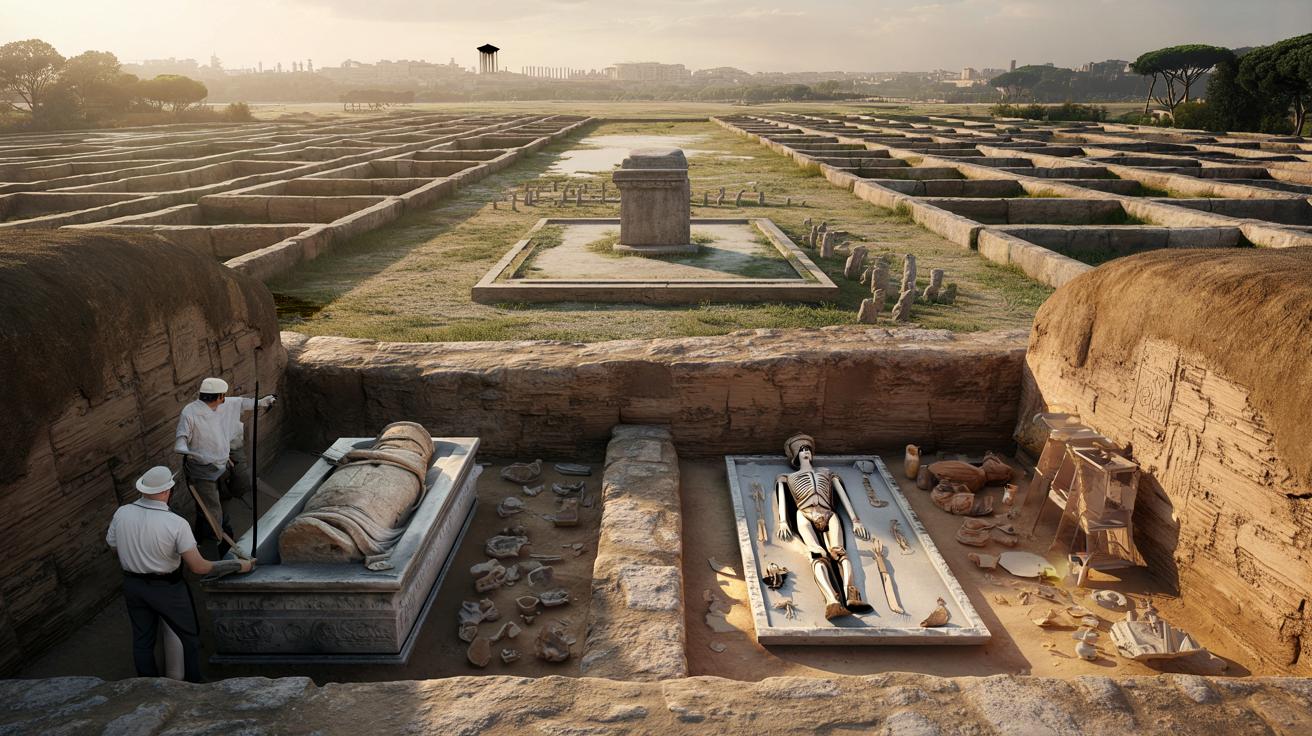
Archaeologists working near Via Pietralata, in northeast Rome, have uncovered two richly appointed tombs dating back more than 2,400 years, alongside what appears to be a shrine dedicated to Hercules. The complex lies outside the line of Rome’s ancient walls, in an area that’s now swallowed by modern housing and infrastructure.
The finds sit within a broader archaeological zone that has been known since the 1990s but only systematically excavated in recent years. The latest phase of work began in 2022 under the direction of state archaeologist Fabrizio Santi, after fresh construction triggered rescue excavations.
The site combines elite burials, a sanctuary, monumental water tanks and an ancient road — all packed into a single suburban strip.
Officials from Italy’s Ministry of Culture say the area functioned as a funerary and cult complex from the late fifth or early fourth century BC through to the first century AD, spanning Rome’s transition from Republic to Empire.
Elite tombs from the Roman Republic
The star finds are two chamber tombs linked to the era of the Roman Republic. Their construction and contents suggest they belonged to an affluent gens — a large extended family that formed a key unit of Roman society.
What the graves contained
One tomb held a stone sarcophagus and three cremation urns, indicating a mix of burial practices within the same family line. The second chamber contained the skeleton of an adult man, laid out for inhumation rather than burning.
- Tomb 1: chamber with stone sarcophagus
- Additional burials: three cremation urns placed alongside
- Tomb 2: chamber with an adult male skeleton
- Social status: consistent with a wealthy, probably landowning family
The combination of a sarcophagus, urns and a separate skeleton points to changing funerary customs between the fifth and third centuries BC, when Romans gradually shifted from cremation to inhumation. It also suggests a lineage maintaining control of the same burial ground across generations.
The tombs hint at a family powerful enough to claim space on a key road near a shrine, but keen to anchor its dead close to a protective deity.
➡️ Here the 2026 Winter Olympics began and here ends the story of a legend of Italian stadiums
➡️ Before Trees, Earth Was Ruled By Giant Life Forms That Seem From Another World
➡️ This European country challenges its arms industry with a homegrown rival to the Tomahawk missile
➡️ China Has Planted So Many Trees It Has Changed The Water Cycle
The Hercules connection
Next to the tombs, archaeologists identified a small cult building — a sacellum, or open-air shrine — that seems to have been dedicated to Hercules. While the central statue that once stood there is missing, the layout and associated finds strongly point to the hero’s worship.
Bronze coins found in the area show the shrine was in use from the late fifth or fourth century BC up to the first century AD. That span covers the period when Hercules was a popular protector for travellers, merchants and soldiers moving in and out of Rome.
Hercules, known as Herakles in Greek myth, was believed to be the son of Zeus (Jupiter for the Romans) and a mortal woman. Roman communities looked to him as a model of strength, endurance and moral fortitude, but also as a guardian against misfortune. Shrines to Hercules often stood near roads, bridges or city gates.
By placing their dead beside a Hercules shrine, local elites were effectively parking their ancestors under the watch of a divine bodyguard.
Monumental water tanks with a sacred role
The Pietralata excavations also revealed two massive stone basins built more than a century after the tombs. Their scale stands out in the suburban landscape, even in fragmentary form.
| Feature | Approximate size | Possible function |
|---|---|---|
| Large tank | 28 m long, 10 m wide, 2.1 m deep | Ritual water use or large-scale collection |
| Smaller tank | Slightly shorter, nearly twice as deep | Immersion rites or controlled storage |
Santi has suggested several interpretations, ranging from ritual installations to water-management or productive structures. The tanks could have supplied purification ceremonies linked to the tombs and shrine, or they may have supported agricultural or craft activities controlled by the same family.
Given the association with Hercules, some researchers are already speculating about water-based rites. In Roman religion, washing hands, sprinkling altars and ritual immersion all formed part of preparing people and spaces for contact with the divine.
An ancient road through a sacred landscape
Cutting through the complex is an ancient road that once guided travellers in and out of Rome’s urban core. The road appears to have led directly to the small Hercules shrine, reinforcing its role as a stopping point for those seeking protection or giving thanks.
In the Republican period, cremation urns and tomb markers often lined the roadside outside city walls. This created corridors of memory that framed the approach to Rome. The Pietralata site fits that pattern, with funerary architecture and a cult space forming a kind of ceremonial gateway to the city.
The Via Pietralata stretch shows how Rome’s suburbs were not anonymous sprawl, but carefully structured landscapes of gods, ancestors and movement.
Beneath the shrine, excavators also found traces of an even earlier votive area, including numerous fragments of pottery figurines. That suggests a long tradition of worship at the spot, predating the formal construction of the Hercules building and linking different phases of local religious life.
From neglected outskirts to archaeological hotspot
The fact that such a complex lies in what is now a typical Roman suburb has caught public attention. For decades, many city-edge districts were assumed to hold little more than scattered farmsteads. Recent digs are overturning that view.
State archaeologists now argue that the suburbs preserve “deep memories” of how ordinary people, not just emperors and generals, shaped Rome’s growth. These spaces held burial plots, small sanctuaries, workshops and farm buildings, all tied into the city’s food supply and road network.
Key concepts behind the finds
For readers less familiar with Roman terms and practices, a few concepts help frame what has been found:
- Gens: a large Roman family group, including living members and honored ancestors, often sharing a name and land.
- Sacellum: a small shrine or sacred enclosure, usually open to the sky, dedicated to a particular god or hero.
- Votive offerings: objects such as figurines, coins or pottery left at a shrine as thanks or requests for divine favour.
The Pietralata site brings all of these elements into focus. A gens appears to have anchored its identity in stone tombs. The group maintained a nearby sacellum for Hercules, and people passing along the road left coins and other offerings in hopes of protection or healing.
What happens next — and why it matters
Now that the main structures are exposed, specialists will run detailed analyses of the human remains, soil samples, and artefacts. DNA and isotope studies on the skeleton could show where the buried man grew up and what he ate. Examination of cremation urn residues might reveal plant oils, perfumes or textiles used in the funeral rites.
Urban planners in Rome face a familiar dilemma: how to protect and study ancient remains without freezing modern development. In many recent cases, authorities have adapted construction projects around key features, leaving some visible and re-covering others for preservation.
For visitors and locals, sites like this can reshape how they think about the city. Instead of imagining a sharp divide between “historic centre” and anonymous outskirts, people begin to see a patchwork of ancient micro-worlds under the pavements — shrines to Hercules, family tombs, farm plots and roadside inns.
For anyone interested in ancient history, these finds also offer a practical reminder: when reading about Rome, paying attention to the suburbs, minor deities and family plots often reveals more about everyday life than a focus on emperors alone.