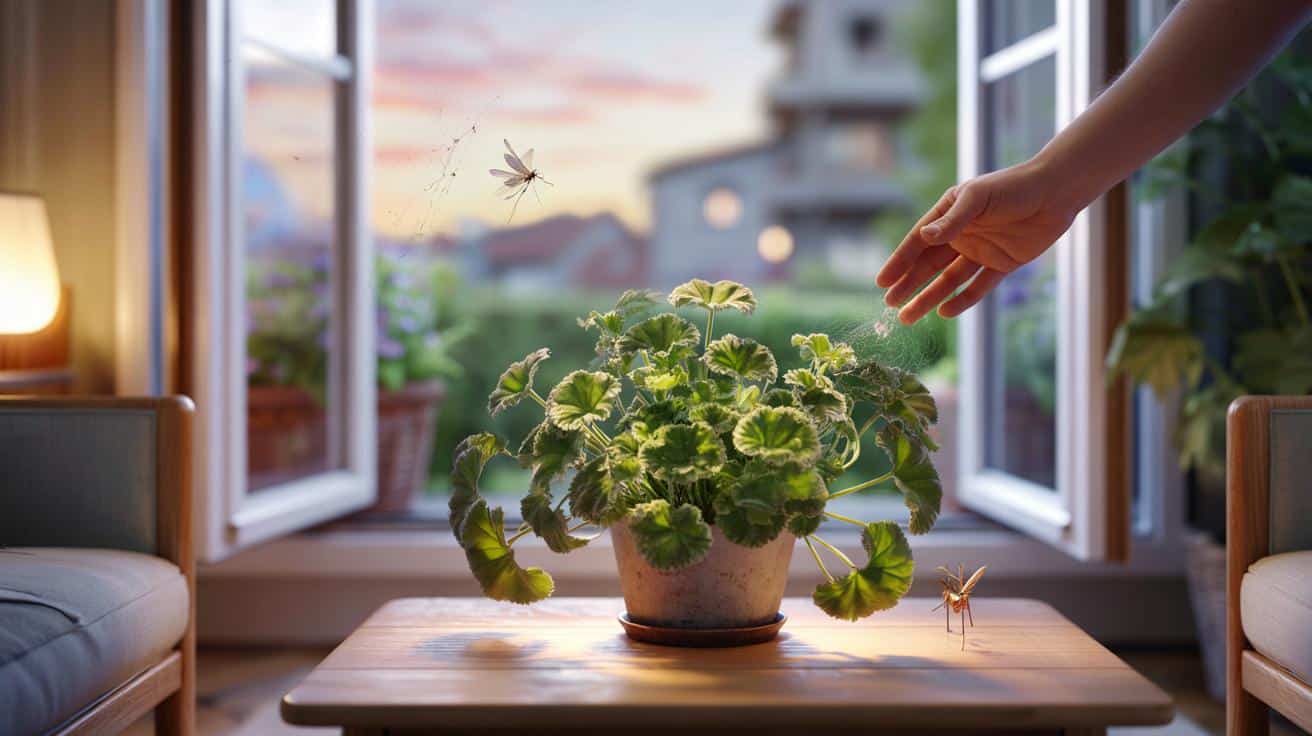
The first evening you leave the windows open in spring, you remember why you’d almost forgotten summer: that soft air, the distant noise of the street… and the first high-pitched whine in your ear. You slap, you wave your hands around, you turn on a lamp to hunt the invisible culprit. Meanwhile, on the coffee table, a jar candle struggles to mask the smell of chemical repellent starting to cloud the room.
Then someone you know casually says, “Why don’t you just get a mosquito plant?” as if this mystical object had been on supermarket shelves your whole life. A plant that smells good, looks decent in the living room, and sends mosquitoes packing? It sounds like a Pinterest myth.
Except this time, the rumor is rooted in something very real.
The scented “mosquito plant” everyone is hunting this spring
The plant people are rushing to buy has a simple name on the label: citronella geranium, often called the mosquito plant. At first glance, it looks like a pretty, slightly wild pelargonium with frilly leaves you want to touch. The magic happens when you crush one gently between your fingers.
A lemony, almost peppery scent explodes, strong enough to perfume a corner of the room. The smell clings to your skin and seems to build an invisible bubble around you. Not clinical, not artificial. Just fresh, a little herbaceous, like a walk in a garden after rain.
You see the craze every April and May at garden centers. People lean over the benches, rubbing leaves, sniffing, comparing. The same scene repeats: a face lights up, someone calls their partner, “Smell this one, that’s the one they say repels mosquitoes!” Several pots disappear into carts, next to soil bags and hopeful basil plants.
There’s a slightly conspiratorial tone in those aisles. Like shoppers are in on a small secret that hasn’t yet reached everyone. Some share stories: “We had friends over last summer, we sat by the window with this plant next to us, and no one got bitten.” One good experience is enough to create a small legend.
Behind the legend sits something concrete: the citronella geranium is rich in aromatic compounds like citronellol, geraniol, and citronellal. These natural substances are the same family as those used in sprays and candles. Mosquitoes don’t love that cocktail. The scent confuses their sense of direction, masks human odors, and makes the area around the plant less attractive.
That doesn’t mean it’s a magical invisible shield that empties your house of every insect. It’s more like a local bodyguard. Positioned near a doorway, window, or table, it creates a scented zone that makes bites less likely. A living diffuser, powered by soil and water instead of batteries.
How to use citronella geranium so it actually works
To get real effect from a citronella geranium, placement is everything. You don’t buy this plant to leave it sad and forgotten in a dark hallway. Put it where air circulates and you actually live: by the balcony door, near the sofa, on a windowsill where breezes flow in at dusk.
➡️ “I didn’t notice how irregular my days were”: until fatigue settled in
➡️ Neither boiled nor raw : the best way to cook broccoli for maximum antioxidant vitamins
➡️ With its 337 metres and 100,000 tonnes, the world’s largest aircraft carrier rules the oceans
➡️ Expanding AI Career Access Through Skills Based Evaluation
➡️ Starlink introduces portable satellite internet service: no setup or new handset necessary
➡️ If you remember these 10 moments from decades ago, your memory is sharper than most in their 70s
Every time you pass, gently crush a leaf or two between your fingers. That simple gesture releases a burst of fresh essential oils into the air. The more regularly the leaves are touched, the more the plant plays its role as a natural perfume and mosquito discourager.
Most people lose their citronella geranium not to insects, but to overwatering or lack of light. This plant loves bright spots and hates having its roots constantly soaked. Let the top of the soil dry out between waterings. If the leaves start to yellow and the stem base looks mushy, you’ve been too generous with the watering can.
We’ve all been there, that moment when you realize your “anti-mosquito” plant is actually dying on your watch. The good news is that citronella geranium is forgiving. A prune, some sun, and a lighter hand with water, and it often bounces back like nothing happened.
You can go further and turn this plant into a small home ally. Before an evening on the terrace, you can pick a few leaves, crush them lightly and place them on the table or near your chair. Some people even rub the leaves gently on exposed skin, like wrists and ankles.
*One gardener I met summed it up perfectly: “I don’t pretend my citronella geranium is a scientific force field. But when I sit next to it, candles off, windows open, I simply get fewer bites. And my living room smells like a garden instead of a pharmacy.”*
- Place it by windows and doors for a scented “gateway” that mosquitoes dislike.
- Crush a few leaves at dusk to boost the aroma right when insects become active.
- Combine the plant with nets or light clothing on high-mosquito evenings for extra safety.
- Repot it in a slightly larger container with draining soil so it grows dense and leafy.
- Take cuttings in late spring to multiply your mosquito plants on the cheap.
Why this little plant changes the mood of a whole home
What really seduces people isn’t just the idea of fewer mosquito bites. It’s the shift from “defensive” home to “living” home. A citronella geranium on a windowsill sends a quiet message: here, we open the windows wide, we let the evening in, and we rely on green allies more than aggressive sprays.
Let’s be honest: nobody really follows all the recommendations about peak mosquito hours, long sleeves, and never leaving a light on near an open window every single day. The plant is not a perfect solution, it’s a gentle compromise. A way of saying, “I want comfort, but I also want air, scent, and something alive next to me.”
| Key point | Detail | Value for the reader |
|---|---|---|
| Natural fragrance | Lemony, fresh scent released when leaves are touched or brushed | Perfumes the home without synthetic candles or sprays |
| Mosquito deterrent | Contains citronellol, geraniol and citronellal that disturb mosquitoes | Reduces bites around windows, balconies and evening sitting areas |
| Easy to grow | Loves light, moderate watering, simple pruning and can be multiplied by cuttings | Affordable, durable solution that improves over time |
FAQ:
- Does citronella geranium completely eliminate mosquitoes?Not entirely. It reduces their presence in the immediate area and helps limit bites, especially near the plant, but it doesn’t act like a 100% protective barrier.
- Can I grow a mosquito plant indoors all year round?Yes, as long as it gets plenty of light, ideally by a sunny window. In winter, it grows more slowly but usually survives well in a bright, cool room.
- Is citronella geranium safe for children and pets?The plant is not considered highly toxic, but it’s not meant to be eaten. Place it where toddlers and pets won’t chew the leaves, and use common sense as with any ornamental plant.
- Does the plant work even if I don’t touch the leaves?It has a light natural scent on its own, but rubbing or slightly crushing the leaves really boosts the aroma and the repellent effect around it.
- Where can I buy a real mosquito plant and not a lookalike?Look for “Pelargonium citrosum” or “citronella geranium” in garden centers in spring, or ask staff directly. They’re often placed near aromatic plants and labeled as mosquito-repellent pelargonium.