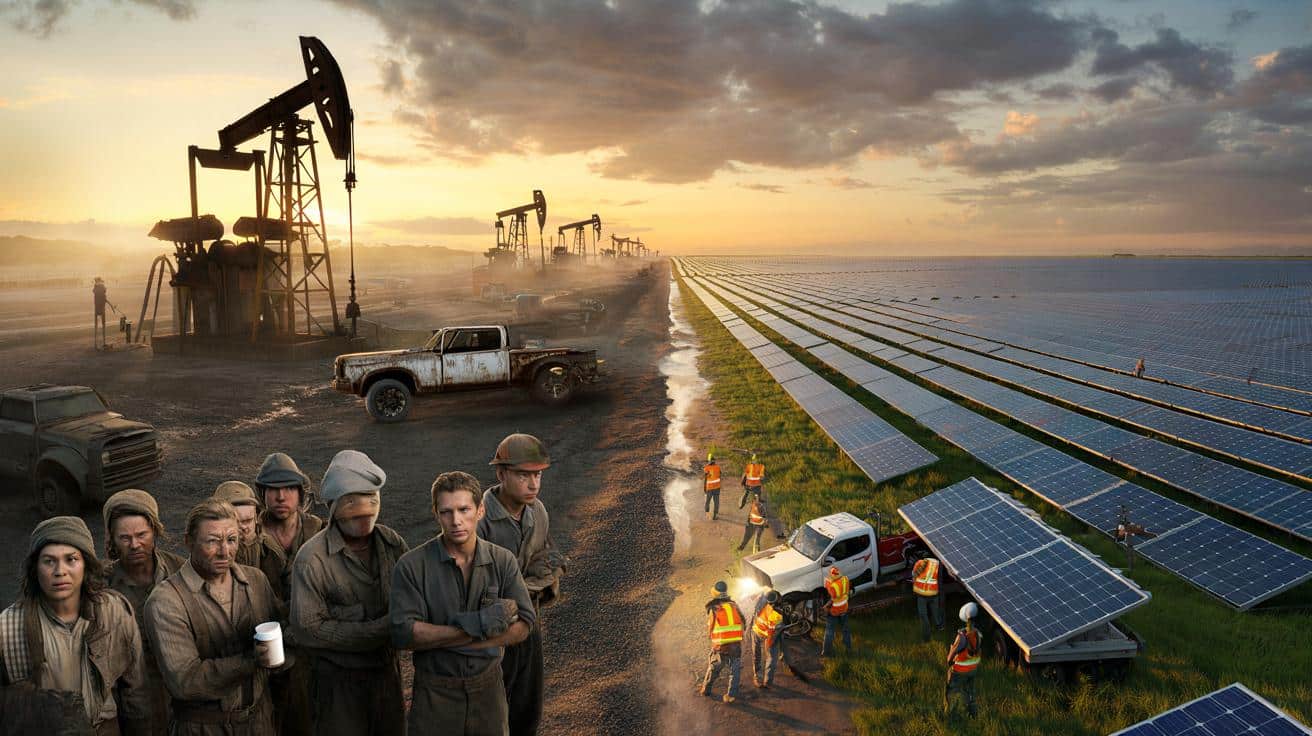
The volunteers arrived before dawn, silhouettes against the rusty pumps of a West Texas gas station. A line of pickup trucks faced a horizon pricked with oil derricks, still nodding like stubborn old men who don’t know when to quit. On the other side of the road, workers in bright vests were unloading gleaming blue solar panels, stacking them like oversized tiles for some futuristic roof.
A few of the oil guys watched in silence. Arms crossed. Coffee cooling in their hands.
Across the world, in reports and conference rooms most of them will never see, experts now speak bluntly: solar can’t just be one energy source among many, it has to become the only one. And the people whose lives were built on coal, oil, and gas? Some analysts call them collateral damage in a necessary war.
The strange part is how normal the morning still feels.
Solar as the “only way out” — and the human cost nobody wants to own
Scroll through climate reports from the last three years and a pattern jumps out. The language has sharpened. No more vague pledges to “reduce reliance” on fossil fuels one day. The message from many scientists and policymakers is far more brutal: if we want a livable planet, we have to stop burning fossil fuels almost entirely, and fast.
Solar sits at the center of this push. It’s cheap, getting cheaper, and can be installed almost anywhere. For experts looking at charts, the logic feels clean and obvious. For the people whose names don’t appear in those reports, the story feels very different.
Take Bełchatów in Poland, home to one of Europe’s biggest coal power plants. For decades, its giant gray chimneys paid for groceries, mortgages, school trips. Now the plant is scheduled to close by 2036, replaced partly by solar and wind. On paper, that’s a climate win. On the ground, it’s a town wondering what happens when the last paycheck tied to coal runs out.
Or look at India, where solar farms are spreading across desert plains. Each megawatt installed is a trophy for energy independence, a line item in a minister’s speech. Yet for every enthusiastic investor, there’s a refinery worker doing the quiet math of “how many years do I have before my skills are useless?” That gap between global graphs and local fears is where the real battle is being fought.
Analysts sometimes talk about this as an “energy war”: fossil fuels on one side, renewables on the other. In war, you count casualties. The phrase “collateral damage” has started slipping into energy debates, used to describe truck drivers hauling diesel, platform workers on offshore rigs, engineers who spent 20 years learning to coax a few more drops from aging wells.
From a climate perspective, the push sounds ruthless because the physics are ruthless. Carbon doesn’t negotiate. Yet jobs do, and identities do. When experts insist that solar must dominate the entire energy system, they’re not just talking about panels and grids. They’re quietly declaring the end of a whole culture built around pulling fuel from the ground.
➡️ After Replacing 90% Of His Staff With AI, An Indian Founder Reveals An Unexpected Outcome
➡️ If you remember these 10 moments from decades ago, your memory is sharper than most in their 70s
➡️ 2,400-year-old Hercules shrine and elite tombs discovered outside ancient Rome’s walls
➡️ Microwaving a lemon : A simple kitchen trick you’ll keep using
How a “solar-only” future is being engineered — and where workers fit in (or don’t)
Watch how the transition actually happens and you see a kind of choreography. First comes the policy signal: bans on new gas boilers, deadlines for coal plant closures, generous tax credits for rooftop solar. Then the money follows. Banks shift investments. Pension funds drop oil stocks and chase green bonds.
After that, the real shift starts: training programs, retraining centers, short courses in solar installation for electricians, welders, and ex-rig workers. Some of these programs are genuinely thoughtful. Some are rushed, box-ticking exercises. The promise is that a roughneck in North Dakota can become a solar technician in two semesters. Sometimes that happens. Sometimes the jobs never arrive in the same town.
We’ve all been there, that moment when someone announces a “fair transition” like it’s a simple software update. For the person being “transitioned,” it feels more like a factory reset. You hear it in Port Arthur, Texas, where refineries light up the night sky and generations of the same families have worn the same company logos. When a big solar developer held a “career event” there, dozens of refinery workers turned up. They left with glossy brochures, a few email addresses, and the quiet suspicion that most of the good jobs would land 200 miles away.
Let’s be honest: nobody really does this every single day — uproot their life, move states, and start a new trade in midlife just because a consultant’s slide said it was rational.
The logic behind a solar-only grid is seductive. Panels have no fuel cost. Once installed, they just sit there, silently turning sunlight into electricity. Pair them with batteries, smarter grids, and backup from wind or hydro, and you can cover almost every hour of the year. That’s the theory underpinning the most ambitious climate scenarios.
Critics point out the messy details: jobs in solar are often more fragmented, scattered across construction sites, rooftops, and deserts. A coal plant employs a stable, long-term workforce in one place. A solar boom can feel like a series of short-term gigs spread over a vast area. The spreadsheets don’t capture the anxiety of wondering what happens after the last panel is bolted down.
Plain talk about sacrifice, justice, and what a real “energy war” would look like
If we strip away the slogans, a genuine “energy war” would mean calling things by their real names. When experts say solar must become the dominant, almost exclusive power source, they’re asking societies to accept upfront pain to avoid far worse pain later. That means not pretending everyone will come out ahead. It means openly saying: some regions will lose revenue, some workers will lose status, some communities will feel betrayed.
A more honest transition starts by mapping that pain in detail. Where are the refineries, the gas fields, the coal ports? Which schools, hospitals, and small shops depend on them? Only then do retraining and “green jobs” start sounding like a plan instead of a slogan.
The biggest mistake is speaking in clean abstractions. “We’ll create 10,000 green jobs” sounds great in a press release, but it’s not what a 54-year-old driller hears. He hears: my knees already hurt, my mortgage still has eight years, my kids are halfway through college. An empathetic transition doesn’t romanticize his sacrifice, it reduces how much sacrifice is actually required.
That might mean paying people to retire early, not just to “re-skill”. It might mean guaranteeing salaries for five or ten years while they move into grid maintenance, safety inspection, or local solar cooperatives. *It definitely means involving workers at the table, not just as a statistic in a “stakeholder” column.*
“People talk about stranded assets,” a former offshore worker in Aberdeen told me. “They mean pipelines and platforms. I’m a stranded asset too. Where’s my bailout?”
When you listen to voices like his, the so-called “necessary war” starts to look less like a battle between good and evil and more like a series of trade-offs that should be named out loud. One way to think about a fairer path is to flip the usual order of priorities:
- First, protect people: guarantee income floors, pensions, and healthcare during the transition.
- Then, transform places: invest in new industries where fossil jobs are disappearing, not just where land is cheap.
- Only after that, celebrate the tech: the panels, batteries, and shining statistics for the next climate summit.
This isn’t softness. It’s strategy. You don’t win a long war by burning through your own soldiers.
What if the “collateral damage” walked away from the fight?
Imagine, just for a moment, that fossil fuel workers globally simply refused the role assigned to them — no longer quiet casualties in someone else’s scenario. In some places, that’s already happening. Oil unions are demanding stakes in offshore wind. Coal regions are negotiating binding guarantees before accepting mine closures. These acts don’t slow the solar surge; they shape it.
The experts are right about one thing: the physics leave very little room. A world that keeps burning coal, oil, and gas like we do today will be harsher, hotter, and crueler than most of us want to imagine. Yet the social physics matter too. Push millions of people into a corner, call their ruin “collateral damage,” and they will push back. At the ballot box. In the streets. Sometimes by voting for leaders who promise to drill forever, no matter what the atmosphere says.
Somewhere between those two cliffs — planetary breakdown on one side, political revolt on the other — lies a narrow path where solar really does become the backbone of our power, and the people who kept the old world running are treated as something more than expendable. Whether we find that path depends less on the panels we install than on whose stories we center while we install them.
| Key point | Detail | Value for the reader |
|---|---|---|
| Solar dominance is not a distant idea | Experts now model futures where solar provides the vast majority of global electricity | Helps you understand why policy and prices are shifting so fast around you |
| Workers are being treated as collateral | Whole regions built on fossil fuels face job loss, identity loss, and social unrest | Gives context for the anger, fear, and resistance you see in news and politics |
| A fairer transition is still possible | Income guarantees, local investment, and worker voice can change the story | Offers concrete levers citizens and communities can demand, rather than passive acceptance |
FAQ:
- Question 1Are experts really saying solar should be the only power source?
- Answer 1Most serious models still include some mix of wind, hydro, geothermal, and a bit of backup from other sources. What many experts argue is that solar will need to be the dominant, central pillar of electricity generation, covering a huge share of demand to meet climate goals.
- Question 2Why are fossil fuel workers called “collateral damage”?
- Answer 2Because the global conversation often focuses on emissions and technology, not on the specific people who lose their jobs or see their towns decline. Their losses are treated as a side effect, not a central problem to solve, which mirrors the language of war.
- Question 3Will solar really create more jobs than fossil fuels destroy?
- Answer 3Many studies suggest that net job creation in renewables can surpass losses in fossil industries. The catch is geography and timing: new jobs may not appear in the same place, at the same time, or for the same people who are losing theirs.
- Question 4Can fossil fuel skills transfer to solar and renewables?
- Answer 4Often yes. Electricians, welders, engineers, and heavy equipment operators have skills that can be adapted. The real obstacles are pay gaps, location, and the cost—financial and emotional—of retraining mid-career.
- Question 5What can ordinary people do in this “energy war”?
- Answer 5You can support policies that cut emissions while funding real transition plans for affected workers, not just vague promises. You can choose clean energy options where offered, back local training programs, and vote for leaders who talk honestly about both climate physics and social justice, not just one side of the story.