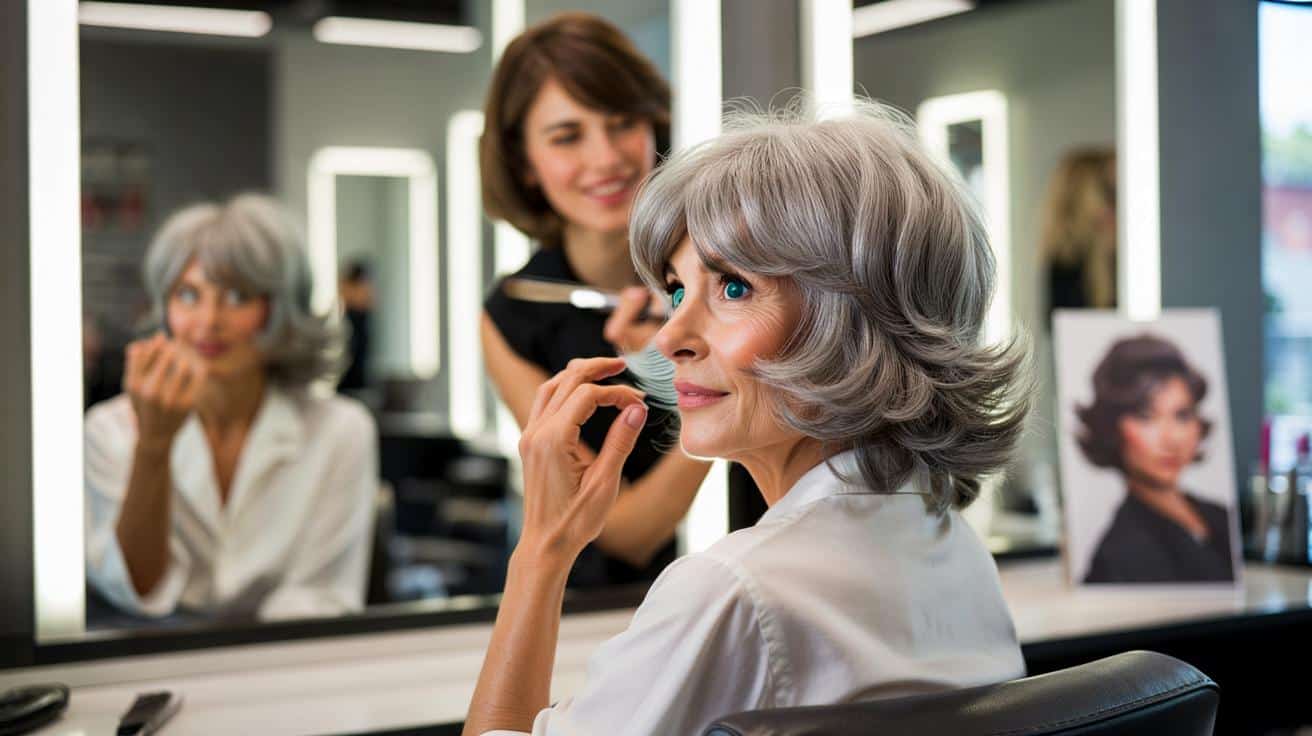
The woman in front of the salon mirror hesitates, fingers gripping the arms of the chair a bit too tightly. Her hair is long, gray, and tied in a low bun she has worn for years “because it’s age-appropriate.” The stylist, barely thirty, smiles and gently lifts the bun, letting the hair fall. “What if,” she says, “we stopped trying to look ‘appropriate’ and tried to look like you?” The woman laughs, a little defensively. “At my age, I’m supposed to cut it short and play it safe, right?” The stylist shakes her head. “At your age, you’ve earned the right to have fun.”
The scissors click. A few bold snips. The outline in the mirror changes, almost like a filter being lifted from a photo. Not younger in years. Younger in energy.
The cut that does this has a name. And stylists quietly agree it’s the most youthful one after 60.
The cut that erases ten years of “respectable” hair in one go
Ask a dozen professional hairstylists what looks most youthful after 60, and surprisingly few will say “long layers” or “classic bob.” Again and again, one answer comes up: the modern shag or shaggy, layered crop. Not the wild 70s rockstar version. A softer, airy version, with light, broken layers, movement around the face, and a slightly undone finish. The kind of cut that looks like you just woke up fabulous, not like you spent an hour with a round brush.
What makes this cut special is not just the length. It’s the way the layers lift the hair away from the face, uncover the eyes, and create a halo of texture. That’s what gives it that unmistakable “spark.”
Picture Françoise, 67, retired teacher, who arrived at her salon with hair she’d worn in the same pageboy cut for two decades. “Don’t make me look like my students’ grandmother,” she joked, before realising that’s exactly how her current style read. Her stylist suggested a mid-length shag: just above the shoulders, with wispy bangs grazing her brows and soft layers that flicked out naturally.
When she saw the result, she touched the ends with both hands like someone testing new fabric. Her jawline looked sharper. Her neck longer. The little crown of volume at the back took five years off instantly. A week later she texted the salon: “Three people told me I look rested. I didn’t sleep more. I just cut my hair.”
That’s the quiet power of a youthful cut: it changes how other people read your face, without screaming, “I’m trying to look younger.”
Why does this style win so many hairstylists over? It plays with three elements that naturally shift with age: density, texture, and facial structure. Hair tends to thin and fall more flatly along the skull; harsh, blunt lines emphasize that flatness and draw the eye down. The modern shag does the opposite. It builds soft volume at the crown, breaks up heavy lines, and brings movement back where the hair usually droops.
The face also subtly changes: cheeks lose volume, the jaw softens. Strong, geometric cuts can harden these features, while soft layers and airy bangs blur transitions. *Youthful hair at 60 isn’t about hiding age, it’s about letting light and air hit the right places.* That’s why so many stylists secretly wish their clients over 60 would dare to ask for this cut instead of “just a trim.”
➡️ If you’re over 60, this is why prolonged sitting feels harsher
➡️ How to house dairy calves properly?
➡️ After Replacing 90% Of His Staff With AI, An Indian Founder Reveals An Unexpected Outcome
➡️ Here the 2026 Winter Olympics began and here ends the story of a legend of Italian stadiums
How to ask for the most youthful cut in the salon chair
The magic phrase to bring to your stylist is not “Make me younger.” It’s “I’d like a soft, layered shag or shaggy crop, with movement around the face.” Show a photo, yes, but also describe how you live. Say if you wear glasses. Say if you hate styling tools. The stylist needs that map.
For many women over 60, a length between the cheekbones and the collarbone is the sweet spot. Short enough to feel light and modern. Long enough to tuck behind the ears or clip back on busy days. Then it’s about the details: a veil of bangs to soften forehead lines, invisible layers that lift the crown, lighter tips to avoid the “helmet” effect. The goal is a cut that falls into place when you shake your head, not only when you’ve blow-dried it into submission.
There’s a trap many fall into after 60: the “safety” haircut. That rigid bob they’ve seen on every TV presenter of a certain age. Or the ultra-short, ultra-neat crop that demands a salon visit every four weeks. These styles aren’t bad, but they can freeze the face in a certain era. The modern shag, on the other hand, accepts that hair has its own will and uses that to your advantage.
Be honest with your stylist about what you actually do at home. If you barely own a brush, say so. If your hands are less agile than before, say that too. Let’s be honest: nobody really does this every single day. A good shag-inspired cut is self-sufficient. It looks on-purpose even with air-drying and a quick scrunch of mousse or styling cream. That’s real-life youthfulness: not perfection, but ease.
“Women over 60 often come in asking for something ‘age-appropriate,’” says London-based stylist Maya Hart. “I tell them: age-appropriate is whatever makes your eyes light up when you see yourself in the mirror. For many, that ends up being a layered, shaggy cut with soft bangs. It liberates their face. They walk out differently.”
- Ask for softness, not sharpness
Request feathered ends, invisible layers, and a light, mussed finish rather than rigid, graphic lines. - Think forehead and eyes first
Talk about bangs or a fringe that skims the brows to frame your eyes without boxing in your face. - Consider your hair’s natural behavior
Fine, straight hair needs subtle, internal layers; thick or wavy hair can handle more texturing and drama. - Plan around your lifestyle
Tell your stylist how often you realistically come back and how long you want to spend styling each morning. - Bring three photos, not twenty
Choose images of women close to your age, with similar hair type. It keeps expectations grounded and conversations clear.
Beyond the cut: what this “younger” style really changes
Something subtle happens when a woman over 60 walks out of a salon with this kind of cut. She doesn’t just look different; she occupies space differently. Hair that moves when you move changes how you feel in your skin. That light bounce at the crown. The strand that falls across your forehead when you laugh. You instinctively reach up, push it back, and in that gesture, you see yourself as animated again, not “fixed” in place.
Many women say the modern shag gives them permission to break other quiet rules they’d been following since their forties: they change their glasses, dare a bolder lipstick, stop apologizing for their age. One haircut can’t solve everything, obviously. Yet it often becomes the very visible first step toward a version of yourself that feels less cautious and more alive. And that, more than the shape of the layers, is what reads as youth to everyone who meets you.
| Key point | Detail | Value for the reader |
|---|---|---|
| Choose a modern shag or shaggy crop | Soft layers, movement around the face, light bangs, mid-length | Instantly fresher, less “classic grandma” look without drastic change |
| Work with your hair’s natural texture | Adapt layering to fine, thick, straight, or wavy hair for easy styling | Hair that looks good with minimal effort and fits daily life |
| Talk lifestyle, not just length | Explain how you style, how often you visit the salon, what you’ll actually do | A cut that stays flattering for weeks and feels like you, not like a cosplay |
FAQ:
- Question 1Isn’t a shag haircut too “rock’n’roll” for someone over 60?
- Answer 1Not the modern version. Today’s shag is softer, more polished, and tailored. The layers are lighter, the lines are blurred, and the result looks effortless, not rebellious.
- Question 2What if I have very fine, thinning hair?
- Answer 2A good stylist will use subtle, internal layers to create volume at the crown without shredding the ends. Keeping the length between chin and shoulders helps the hair look fuller.
- Question 3Can I wear this cut with natural gray or white hair?
- Answer 3Yes, and it often looks spectacular. The texture of a shag makes silver highlights sparkle and breaks up any “helmet” effect gray hair can have when cut bluntly.
- Question 4Does this style require a lot of maintenance?
- Answer 4Most women are fine with a trim every 6 to 8 weeks. At home, a bit of lightweight mousse or styling cream and air-drying are usually enough for a lived-in finish.
- Question 5What should I tell my stylist if I’m scared of a big change?
- Answer 5Say you want to “start soft”: keep the length you’re comfortable with, add gentle layers only around the face, and maybe a light fringe. You can always go shaggier at the next appointment.