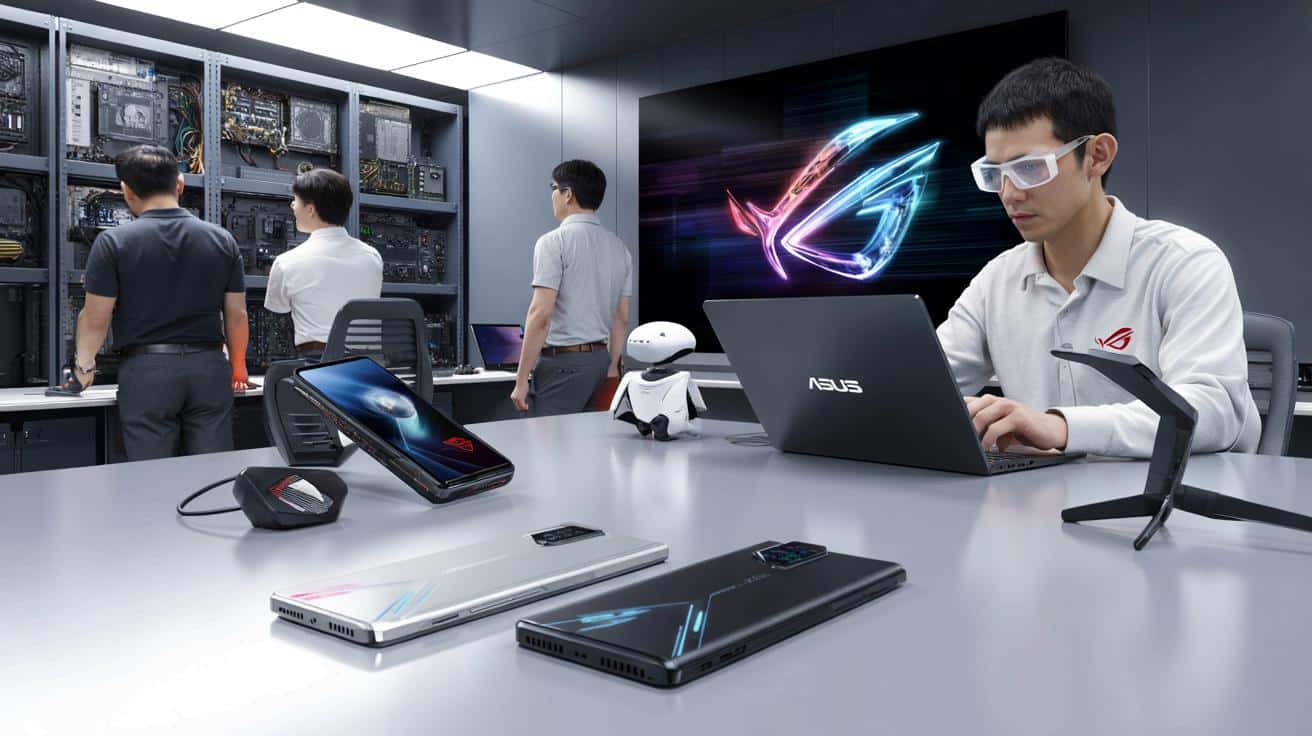
Asus, long a niche favourite among power users and mobile gamers, has confirmed it is shutting down its smartphone business for good and redirecting its energy – and money – toward artificial intelligence.
From cult phones to a hard stop
On paper, Asus was never a heavyweight in global smartphones. According to figures reported by Tech in Asia, the company held roughly 2.8% of the worldwide market. Yet its impact was far bigger than that number suggests.
The Zenfone line built a reputation for clean software, strong performance and surprisingly compact flagships at a time when big brands kept making phones larger. The ROG Phone series, designed for gamers, pushed specs and cooling systems to extremes, often setting the benchmark for raw power.
Asus has officially halted all future Zenfone and ROG Phone development, bringing its mobile chapter to an end.
That chapter closed during an internal company meeting, where Asus president Jonney Shih told employees there would be no new smartphones. The decision confirms what industry watchers had suspected since plans for a 2026 lineup quietly evaporated.
Why Asus is walking away from phones
The smartphone business has become brutally competitive and low margin, especially for brands outside the very top tier. Marketing costs are enormous, component prices are volatile, and differentiation is tough.
For Asus, phones had effectively become a side project compared with its core strengths in PCs, motherboards and gaming laptops. The company appears to have decided that putting more money into a crowded, slow‑growth segment makes less sense than riding the AI wave.
Asus is reallocating resources from phones to AI hardware: servers, laptops, robotics and connected devices.
The new strategy focuses on several fronts:
➡️ Neither boiled nor raw : the best way to cook broccoli for maximum antioxidant vitamins
➡️ France to cut its contribution to the Global Fund to Fight Aids, Tuberculosis and Malaria by 58%
➡️ Tesla invests $2 billion in Musk’s xAI and reiterates Cybercab production starts this year
➡️ The return of the aircraft carrier Truman is seen as a snub to the Navy in the war of the future
➡️ How to house dairy calves properly?
- AI‑optimised servers for data centres and cloud providers
- AI‑centric laptops and PCs, including so‑called “AI PCs” launched at CES in Las Vegas
- Experimental products such as smart glasses and consumer robotics
- Software layers that tie Asus hardware into AI workflows
In practice, that means the company wants to be the brand selling the infrastructure and devices that run AI models, rather than the handset in your pocket running an AI camera filter.
The gamer phone era ends
ROG Phone: a rare kind of excess
The ROG Phone range was one of the last truly specialised smartphones. While rivals tried to please everyone, Asus leaned fully into gaming: giant batteries, high refresh rate OLED screens, advanced cooling, shoulder triggers and docks that turned a phone into a quasi‑console.
Asus also experimented with chunky accessories: clip‑on fans, second‑screen docks, desktop docks for keyboard and mouse. Not all of it was practical, but it made the ROG Phone instantly recognisable and gave mobile gamers a sense that someone was building specifically for them.
That entire line now stops. No ROG Phone 9, no Zenfone rebirth. The company is leaving that niche to others, at least unless a future leadership team decides to pull off another U‑turn.
Zenfone fans lose a rare compact flagship
The Zenfone series mattered for a different reason. In recent years, it was one of the very few Android flagships to stay relatively small, while still offering high‑end cameras and processors. For users who didn’t want a giant slab in their pocket, that made Asus stand out.
With the shutdown of the mobile division, that segment shrinks again. Those wanting a smaller, premium Android phone now have fewer choices, mostly from Samsung or occasional niche models from Chinese brands.
AI bets, higher prices
Asus is not alone in rushing towards AI. Chipmakers, cloud providers, PC brands and software firms are all scrambling for a slice of the same pie. GPUs, high‑bandwidth memory and advanced RAM are in heavy demand. That demand has a side effect: prices.
The AI boom is pushing up the cost of memory and components, feeding into higher prices for laptops and other devices.
Asus itself showcased new AI‑focused PCs at CES in Las Vegas with visibly higher price tags than comparable models from previous years. Part of that reflects more powerful chips and on‑device neural processing units, but part is simple supply and demand.
| Area | Before the shift | After the shift |
|---|---|---|
| Smartphones | Zenfone and ROG Phone, niche but loyal base | No new models, only ongoing software support |
| PCs and laptops | Gaming and creator‑focused machines | AI‑labelled PCs with NPUs and higher prices |
| Data centre | Standard servers and components | AI‑optimised servers and accelerator‑ready platforms |
| Experimental gear | Gaming accessories and docks | Smart glasses, robotics, connected AI devices |
What Asus phone owners should expect
If you’re currently using a Zenfone or ROG Phone, the news sounds alarming, but it doesn’t mean your device is suddenly abandoned.
Asus has indicated that support for existing smartphones will continue. That includes software updates and security patches inside the usual lifecycle. The change affects future production, not current after‑sales commitments.
That said, long‑term realities will shift. Accessories will be harder to find, especially for niche ROG Phone add‑ons. Third‑party ROM support might stay strong in the enthusiast community, but official feature updates will naturally taper off as models age.
What “going all‑in on AI” actually means
AI can sound abstract, so it helps to break down what Asus likely wants to sell over the next few years.
AI PCs and on‑device intelligence
An “AI PC” generally refers to a laptop or desktop with a dedicated neural processing unit (NPU). This chip handles tasks like real‑time background blur, voice isolation, translation and some generative features locally, without sending all data to a cloud server.
For Asus, that opens new product pitches: thinner laptops that still handle AI workloads, gaming rigs that stream with on‑device enhancements, or business laptops that run sensitive AI models offline for privacy reasons.
Servers, smart devices and robots
On the infrastructure side, Asus can supply motherboards and full servers to companies deploying large language models and other demanding AI workloads. Those customers are often willing to pay far more per machine than a consumer will pay for a single handset, which helps explain the strategic pivot.
The company is also talking about smart glasses and robotics. In practice, that could look like augmented reality headsets for industrial workers, companion robots in retail, or warehouse machines guided by AI vision systems. None of these are guaranteed hits, but they sit closer to Asus’s hardware DNA than fighting for shelf space with mid‑range Android phones.
What this means for the smartphone landscape
Asus leaving phones does not shake global market share charts in the way that, say, Samsung exiting would. But it changes the texture of the market in subtle ways.
Fewer brands are now building “enthusiast” phones purely for gaming. Competition in that niche shifts to companies like Nubia’s RedMagic, Lenovo’s Legion experiments and gaming‑focused variants from mainstream brands. Some might try to capture ROG Phone loyalists by copying its triggers, cooling and accessories.
The exit also sends a signal: even a technically capable, well‑regarded brand can find smartphones too tough a business to justify. That message will be heard by smaller OEMs struggling at the lower end of the market.
How consumers can adapt to the AI pivot
For everyday users, the shift from phones to AI hardware brings both gains and trade‑offs. You get laptops that handle more tasks locally, potentially with better privacy and less reliance on constant connectivity. At the same time, device prices creep up as AI‑grade components become standard.
If you care about pricing, one practical move is to pay attention to how much you actually use AI features. A mid‑range laptop without a heavy AI pitch might serve you as well as a flashy “AI PC”, while costing less. On the smartphone side, looking at brands with clear, long‑term update policies becomes even more important, since niche players can bow out, just as Asus has done.