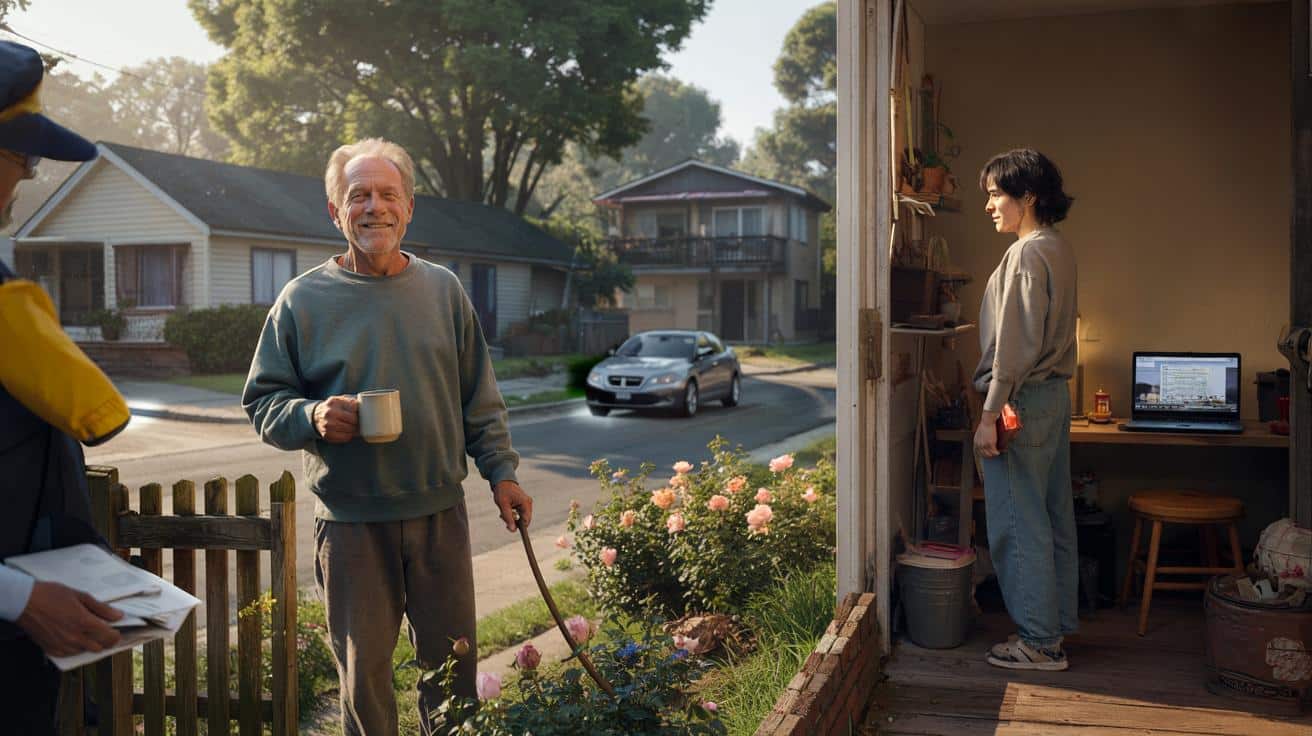
It’s 7:30 a.m. in a quiet suburb. A boomer neighbor in a faded sweatshirt is watering his roses, coffee mug balanced on the fence, chatting with the mail carrier like it’s a daily ritual. No rush, no Zoom, no frantic doomscrolling. Just… a slow morning that actually looks kind of nice.
Meanwhile, a 27-year-old in the apartment across the street grabs an energy drink, half-checks Slack, half-checks TikTok, and already feels late for a life that hasn’t even started yet. The day hasn’t begun, but the anxiety is fully awake.
Same sun. Same street. Totally different weather inside their heads.
Something in that gap feels worth examining.
Why boomers quietly look like they’re “winning”
Walk around any supermarket on a weekday morning and you’ll see them. Boomers moving slowly, reading labels, actually talking to the cashier instead of tapping a card and darting away. They’re not stress-free saints, of course, but many carry a kind of quiet stability that younger people clock instantly.
There’s a mortgage that got paid off years ago. A job that lasted decades. A retirement plan that didn’t come out of finance TikTok. It creates a different baseline of calm.
You can feel it in the way they stand in line without sighing into their phones.
Take Clara, 66, who spent 35 years as a nurse in the same hospital. Her life wasn’t glamorous. No remote work. No “personal brand”. No followers to feed.
She raised two kids, built up a modest pension, paid down a small house in a not-very-cool neighborhood. Today, she volunteers twice a week, takes a ceramics class, and complains about her knees. That’s it.
On paper, it’s ordinary. But her rent doesn’t jump every year. Her student loans don’t follow her into her forties. She doesn’t wake up worrying about engagement rates. There’s a solidness to her life that many thirty-somethings would trade a thousand likes for.
➡️ Here the 2026 Winter Olympics began and here ends the story of a legend of Italian stadiums
➡️ The return of the aircraft carrier Truman is seen as a snub to the Navy in the war of the future
➡️ China Has Planted So Many Trees It Has Changed The Water Cycle
This isn’t just nostalgia talking. Generational data backs it up: boomers were more likely to access stable jobs, cheaper housing, and affordable education. Those things compound over decades into something that looks like “luck”, but really is structural advantage.
Younger generations, raised on constant optimization and algorithmic comparison, are playing a different game. Work is more precarious. Housing eats a bigger share of income. The line between personal identity and public performance is blurred 24/7.
So when a boomer seems oddly chill while a 25-year-old is burnt out and depressed, it’s not because one generation is morally superior. It’s because they were handed a board game with more winning squares.
Likes, burnout, and the invisible race younger people are running
If you’re under 40, your “success dashboard” doesn’t live in a bank statement. It lives on screens. Views. Followers. Responses. That subtle jolt when a notification pops up. These metrics don’t just track life; they invade it.
A boomer might ask, “How’s work?”
A Gen Z or millennial might silently ask, “How do I look living this life?”
That second question turns everything into content: workouts, meals, friendships, even grief. It’s exhausting in ways that are hard to admit out loud.
Picture Mia, 31, a social media manager who half-jokes that she “lives in the algorithm”. She works eight hours a day on brand content, then spends her evenings editing Reels for her own account.
If a post does well, she feels electric. If it flops, she spends the night spiraling, wondering if she’s “falling behind”. Her parents, both boomers, don’t get it. They had bad days; she has bad metrics.
Her dad once told her, “We left our problems at the office when we came home.” She doesn’t have that luxury. Her office is in her pocket, glowing at 2 a.m., whispering that someone else her age is doing more, faster, prettier.
The human brain wasn’t built to compare itself to thousands of lives every single day. Boomers compared themselves to neighbors, cousins, colleagues. A small circle. You might envy the guy with the nicer car, but you didn’t see a never-ending highlight reel of 10,000 strangers.
Younger generations live in a permanent talent show. Work is uncertain, housing unstable, climate anxiety humming in the background, and on top of that, the performance never stops. No wonder burnout hits earlier and harder.
Let’s be honest: nobody really does this every single day without breaking somewhere inside.
What boomers accidentally did right (and what we can steal)
Strip away the generational jokes and memes, and a pattern appears. Many boomers, by circumstance or design, lived with clearer boundaries. Work was work. Home was home. Friends were offline. Weekends weren’t content opportunities.
We can’t go back to 1983, but we can steal a few moves from that playbook. One is creating “closed circles” where life isn’t performed or scored. Group chats that never hit Instagram. Hobbies that never touch LinkedIn. Walks that go untracked.
It’s not about rejecting the internet. It’s about reclaiming moments that exist only for you and whoever shares them in real time.
You don’t have to turn into your dad and throw your phone in a drawer at 7 p.m. You can start smaller. Decide that some things are simply not for public consumption: your first draft, your Sunday mornings, your therapy breakthroughs.
The mistake many of us make is thinking visibility is safety. That if we’re “seen”, we’re secure. It’s the opposite. The more parts of your identity live online, the more fragile you feel when that space turns cold.
Be gentle with yourself about this. You grew up in a system that told you to build a personal brand just to be employable. It makes sense that unplugging feels both desirable and terrifying.
“Boomers built a life, then shared it with a small circle. Younger generations are asked to share first and somehow build a life inside that spotlight.”
- Set a “no-performance” zone
Choose one part of your day where nothing is posted, tracked, or optimized. Even 30 minutes can reset your nervous system. - Keep one hobby completely offline
Paint, garden, learn guitar, bake bread. Do it badly if you want. The point is that nobody ever sees it. - Talk to people who remember the pre-smartphone world
Ask parents, neighbors, older coworkers how they handled boredom, conflict, ambition. Steal any tiny ritual that feels grounded. - Redefine “winning” privately
Write your own scoreboard on paper: sleep, friendships, creativity, stability. Let that matter more than likes for one week. - Accept that some doors were easier for boomers
This isn’t about blaming or self-pity. It’s about adjusting your expectations so you stop hating yourself for not owning a house at 28.
The uncomfortable question: what if “winning” now looks different?
There’s a quiet tension many younger people live with. On one hand, they admire the stability boomers built. On the other, they don’t want that exact life: same job for 30 years, same town, same routine. Something in them wants more freedom, more meaning, more movement.
That’s the paradox. You can’t copy-paste boomer outcomes onto a totally different economic and digital landscape. You can only ask, “Given the world I’m in, what does a good life look like for me?”
Maybe “winning” now is owning less but feeling lighter. Or never buying a house but building a deep web of people who’d show up if your life exploded at 3 a.m. Maybe it’s working three different careers instead of one long ladder climb.
Boomers were dealt some better cards: cheaper education, more accessible home ownership, steadier jobs. Younger generations were dealt others: global networks, faster reinvention, new ways to earn, new spaces to belong.
The trouble starts when we only see the worst of our own deal and the best of someone else’s. The boomer with the paid-off house might feel lonely and stuck. The burned-out 30-year-old might be one boundary shift away from a life that suddenly feels bearable.
We’ve all been there, that moment when you scroll past someone else’s “win” and quietly decide you’re losing. That script was written by algorithms, not by you.
Maybe the real lesson from boomers isn’t “own a house” or “stay at one company”. Maybe it’s quieter: commit to a few things long enough that they start to hold you when life gets shaky. A craft, a neighborhood, a relationship, a weekly dinner, a savings habit that feels boring.
And at the same time, don’t romanticize the past so much that you miss your own possibilities. You can log off without disappearing. You can be ambitious without broadcasting every step. You can care about your future without playing a game that keeps changing the rules.
The next time you see a boomer watering their roses at 7:30 a.m., notice what part of that scene you actually long for. Then ask, honestly: what’s one tiny change today that moves you closer to your version of that calm?
| Key point | Detail | Value for the reader |
|---|---|---|
| Structural advantage matters | Boomers benefited from cheaper housing, education, and more stable jobs | Reduces unfair self-blame and helps reset expectations |
| Digital life fuels quiet misery | Likes, constant comparison, and blurred boundaries feed burnout | Gives language for what you’re feeling so you can change your habits |
| Small, offline rituals are powerful | No-performance zones, offline hobbies, and private scoreboards | Concrete steps to feel more grounded in a chaotic, online world |
FAQ:
- Why do boomers seem less anxious about money?Many entered the workforce when wages and housing costs were better aligned, and long-term jobs with pensions were more common. Over decades, that creates more financial cushion and less day-to-day money panic.
- Are younger generations just more “sensitive”?No. They’re navigating higher costs of living, more precarious work, and constant digital comparison. What looks like sensitivity is often a rational response to chronic pressure.
- Can I ever feel stable without owning a house?Yes. Stability can come from consistent income, strong relationships, reasonable savings, and trusted routines. Property is one path, not the only one.
- How do I stop tying my worth to likes?Start by noticing the urge instead of shaming it. Then gradually move some parts of your life offline and track progress in private ways: journals, checklists, or simple reflections.
- What’s one thing I can copy from boomers starting this week?Pick one small ritual that repeats: a weekly dinner, a fixed bedtime, a Sunday walk without your phone. Consistency, not intensity, is the quiet superpower many boomers unknowingly practiced.